Showing posts with label Olympics. Show all posts

Sunday, January 15, 2023

An afternoon on the Dark Side of Hong Kong during which I saw darkness but also hope

 
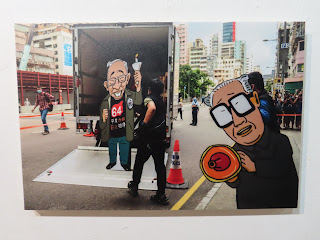
One of the photos on display at an exhibition I went to this afternoon
 
I went to lunch over on "the Dark Side" today.  This is a nickname that Hong Kong expats (who stereotypically live on Hong Kong Island -- and are also are more likely to live on Lamma Island or Discovery Bay than Kowloonside -- have for Kowloon.
 
Along the way, I passed by the building that used to house the June 4th Museum that was dedicated to keeping the memory of the Tiananmen Square Massacre of June 4th, 1989, alive, and which was pressured to close and then was raided by the police in September 2021.  Incidentally, a cavernous cinema known as the Dynasty Theatre used to be located nearby.  I say "used to be" because where the 1,920 capacity screening venue was is curently a building site.  
 
Also previously located in the area was the China Cafe, an atmospheric cha chaan teng that was the location for a number of Milkyway Image movies (including, most famously, PTU).  I have to say that I didn't have the heart to go and see what's now in its place.

After lunch (at a popular eatery that's announced that it will be closing sometime next month -- but hopefully will be reopening at another location), I headed over to check out an exhibition put on by the Hong Kong Press Photographers Association.  Entitled Focus on the Frontline 2021, it comprises prize-winning photographs from journalists who covered a range of events including sporting ones (such as the 2021 Tokyo Olympics) and also those which were darker in nature.  These included the stabbing of a policeman outside the Causeway Bay SOGO on July 1st, 2021, by a man who subsequently killed himself, and also a number that turned out to be related to the commemoration of the Tiananmen Square Massacre here in Hong Kong.

More specifically, there's a photo showing the police loading confiscated June 4th Museum items (that included a cardboard cutout of the late pro-democracy activist-politician and chairman of the Hong Kong Alliance in Support of Patriotic Democratic Movements of China, Szeto Wah, holding a commerative candle in his hand).  There also are photos showing the dismantling and removal of the Pillar of Shame from its previously prominent location at the University of Hong Kong's campus
 
On display at the exhibition too is a photo of Chow Hang-tung, the lawyer-activist who is actively seeking to keep the flame of the Hong Kong Alliance and the right of people to commemorate the Tianamen Square Massacre in Hong Kong alive even while fighting for her own freedom (and against Hong Kong government efforts to keep her in prison for many years to come).  Seeing the image of her with her inflatable bed in her office really hammers home how dedicated and committed to the cause she is, and has been for years now.

A blurb for the exhibition includes the following paragraphs:

In the past few years, the social and media environment in Hong Kong has undergone tremendous changes. Several influential mainstream media and online media have suddenly ceased operations. Become a freelance photographer.

However, while facing the changes, the photographers still only stayed at their posts until the last moment, shooting wonderful news works with historical significance, and witnessing the transformation of the city together with the citizens.

Some of the photographs give one a real sense of the yeoman efforts and work of Hong Kong's press photographers.  Truly, there are times when I think that they (along with many a journalist, editor (like former Stand News chief editor, Chung Pui-kuen  and publisher (notably Next Digital's Jimmy Lai) truly have been pretty heroic; with many of them going beyond the call of duty to make sure people see what's been going on in the world of Hong Kongers.

I also got the sense from the exhibition that many of the photographs were of people that the photojournalists and/or curators of the exhibition respect and admire, and consider heroes too.   These include Olympians who've brought glory to Hong Kong, notably fencer Edgar Cheung Ka-long and swimmer Siobhan Haughey, and also the likes of singer-activist (and former 612 Humanitarian Relief Fund trustee) Denise Ho and filmmaker Kiwi Chow. 

More re Kiwi Chow: his protest documentary, Revolution of Our Times, may never be allowed to be screened in cinemas in Hong Kong but his latest effort, a Chinese New Year comedy entitled Say I Do To Me(!), is scheduled to play in local cinemas over the festive period (and beyond).  And for those who didn't realize: yes, he has remained in Hong Kong all this time.  And it's good to see that he -- and the likes of the similarly openly pro-democracy Anthony Wong Chau-sang -- still are able to find work and an audience in their home city... which may be down and facing dark times but really ought not to be counted out (just yet)!

Monday, November 14, 2022

A Glory to Hong Kong-March of the Volunteers mix-up in Seoul has sent Hong Kong into hysterics! :D

 
The most recent time I've heard the Chinese national anthem
 
A woman was sentenced in a Hong Kong court last Thursday to three months imprisonment for "insulting" the Chinese national anthem -- the first conviction under a law which came into effect on June 4th, 2020 in response to "The March of the Volunteers" having regularly attracted boos from attendees of such as football matches involving the Hong Kong national team.  Citizen journalist Paula Leung was seen waving the British colonial-era Hong Kong flag while "The March of the Volunteers" was being played at a Tokyo Olympics medal ceremony being broadcast live at a mall after fencer Cheung Ka-long won a gold medal for Hong Kong.  That's it.  


Consider this: Executive Councillor Ronny Tong "refused to accept it’s a careless mistake, saying anyone involved may violate [the] sedition law or [national security law]."  This despite it being entirely possible that the junior staffer tasked with getting a copy of the Hong Kong national anthem did not realise that: Hong Kong doesn't have its own national anthem (despite having such as its own national rugby team, Olympic teams, etc.); that the Chinese national anthem also serves as the Hong Kong (national) anthem; and that "Glory to Hong Kong" may be an anthem from Hong Kong but is not the official Hong Kong (national) anthem!
 
 
I have to admit: Junius Ho's comments really did cause me to scoff because it was only two weekends ago that the Hong Kong rugby team played in the same Hong Kong Rugby Sevens that was a major exercise in sportswashing; thanks in no small part to it allowing John Lee and Co to prance around unmasked in Hong Kong Stadium and playing a role in delivering the government's "Hong Kong is back" message.  
 
And in case people didn't realize it: Rugby isn't exactly a popular Hong Kong sport -- with the Rugby Sevens generally being associated more with foreigners and expatriates rather than locals, and the Hong Kong rugby team tending to be less ethnic Chinese than, say, the Hong Kong football, cycling, badminton and table tennis teams.  So more than one person has been moved to wonder whether the majority of the Hong Kong rugby national team players actually recognized that "Glory to Hong Kong" was being played (rather than "The March of the Volunteers") in Seoul, never mind cared at the time!
 
On a personal note: I have to admit that it took me a while myself to realize that Hong Kong didn't have its own anthem (since there is a Hong Kong flag, a designated Hong Kong flower and such).  And since I actually have only heard "The March of the Volunteers" played a handful of times in Hong Kong, it's not a song I'm all that super familiar with!
 
I still recall the time I was at a Hong Kong Philharmic Orchestra concert some years back when the orchestra started playing a piece that most definitely didn't sound like the kind of classical music work that I was expecting to hear from them.  Even more bewildering to me was that some -- but not all -- members of the audience stood up when it was being played.  Truly, it took me a while to realize that the orchestra had elected to play "The March of the Volunteers" on that occasion because the concert took place near October 1st.  And yes, after that, I stopped attending any concerts that took place close to that date; hence my not hearing the national anthem being played at any concert since!  

Wednesday, July 13, 2022

Then they came for the senior citizens and stopped a book fair from taking place...!

  
The senior citizen waving the Union Jack is "Grandma Wong"
 
Since 2019, a saying one hears often being uttered in Hong Kong is that "Being young is a crime in Hong Kong".  This is because it's often assumed by opponents of pro-democracy protestors, including the police, (and also certain "helicopter journalists" who only have a cursory knowledge of Hong Kong) that the vast majority, if not all, of Hong Kong's pro-democracy protestors are youthful university and secondary school students.  
 
To be sure, Hong Kong has (had) its fair share of young political activists -- including 20something year olds like Joshua Wong (who's currently behind bars), Tiffany Yuen (ditto), Lester Shum (ditto), Nathan Law (now in exile) and Agnes Chow (released from prison but seemingly still silenced, like 31-year-old Edward Leung Ting-kei).  But anyone who took part in the Umbrella Movement, and the once annual July 1st and October 1st protest marches as well as extradition bill protests -- not to mention the June 4th candlelight vigil, which is particularly known for drawing older crowds -- will be able to attest, there are many gray- and silver-haired folks among Hong Kong's pro-democracy protestors and activists too.
 
Just consider the not inconsiderable of older folks who have been arrested for on charges to do with protesting (ranging from taking part in "unauthorized assemblies" to those covered by the draconian national security law).  Among the more well known are: Jimmy Lai (aged 74 years and currently behind bars); 84-year-old Martin Lee and 74-year-old Margaret Ng (who were handed out suspended sentences); and 90-year-old Cardinal Joseph Zen (arrested in May (along with others including -- again! -- Margaret Ng, and whose trial has not yet concluded). 
 
And joining Joshua Wong, Tiffany Yuen, Lester Shum, Jimmy Lai and co behind bars in recent days are two more senior citizens.  Yesterday saw 76-year-old, stage four cancer sufferer Koo Sze-yiu sentenced to nine months imprisonment for his having planned to stage a non-violent protest against the Beijing Olympics in Hong Kong (so, yes, several thousands of kilometers away from any of the Olympic sites) after "the principal magistrate ruled that the offence Koo committed amounted to endangering national security".  
 
 
You know the "Captain, it's only Wednesday" meme?  And yes, well, it really is only Wednesday.  Adding to this week's and today's sense of gloom: News came this afternoon that an alternative book fair planned for publishers banned from taking part in this year's Hong Kong Book Fair has had to cancel the day before it was due to take place after the venue owner decided to disallow the use of his venue for itAmong the planned book fair's organizers and participants was Hillway Culture, whose stall at last year's Hong Kong Book Fair included advertising for, and copies for sale of, a bilingual graphic novel version of George Orwell's Animal Farm with illustrations by now exiled cartoonist VA Wong Sir.          

As far as I know, George Orwell's books are still available for sale in many a Hong Kong bookstore. But, truly, it's small consolation for increasingly feeling like one is living in a real life version Animal Farm meets 1984 with doses of works by Kafka, and other dystopian tales thrown in for good measure, though!  And this even when/though one hasn't been arrested, charged with some ridiculous crime and thrown in jail -- touch wood/yet!

Monday, June 6, 2022

An unhappy start to a new week with talk of possible life sentences for a number of Hong Kongers and news of more departures of others

Claudia Mo is one of a number of Hong Kongers who has been 
silenced and behind bars for some 15 months now -- and 
is facing greater punishment down the road :(

After a disturbing week which culminated in Hong Kong showing its police state colors on Saturday, June 4th, I was hoping that today would be the start of a less troubled week in Hong Kong.  Alas, the 10th anniversary of the (suspicious) death of Li Wangyang has been one which has seen Hong Kong saddled with more bad news as the authorities continue waging lawfare on the territories' embattled pro-democrats.   

Among today's upsetting news was that involving 75-year-old activist Koo Sze-yiu, who was arrested in February and charged under the colonial-era sedition law over a protest that was planned against the Beijing Winter OlympicsThe trial of Mr Koo, who also happens to have Stage 4 cancer, got going today with Principal Magistrate Peter Law, one of Hong Kong's handpicked national security judges, presiding.  And to judge from Magistrate Law's past record, the elderly member of the League of Social Democrats is not going to be shown much mercy at all.

Peter Law also was busy today transferring the national security law case involving folks arrested in February 2021 for having organized or taken part in primary elections staged in July 2020 from the West Kowloon Magistrates' Court, where he is based, to the High Court.  What this means in legal terms is that the defendants now face higher sentences than would have been the case if their case were heard at the lower court.  Specifically, the defendants -- the vast majority of whom have been behind bars since February 28th, 2021 -- are now facing the possibility of life in prison.  

Quite apart from the sheer ludicrousness of people being given any jail time for organising and participating in primary elections aimed at gaining a controlling majority in the legislature (something which politicians in democratic countries try to do as a a matter of course, and considered legal, of course!), it is absolutely horrifying to consider that these individuals include some of the most admired, respected and loved politicians and activists in Hong Kong.  And then there's the matter of some of them who now look to be facing -- and given -- a life sentence are so young: with the likes of Joshua Wong, Tiffany Yuen, Lester Shum (one of the faces of the 2014 Occupy phase of the Umbrella Movement) and Ventus Lau (who organised a number of extradition bill protest marches and rallies) being just in their 20s.  

Small wonder then that so many people are seeing no future for themselves in Hong Kong, and also for Hong Kong itself.  And, as a matter of fact, yesterday saw reports of a third political cartoonist having left Hong Kong in less than seven weeks, citing the loss of artistic freedom.  The departure of the artist known as "Hong Kong Worker" follows in the wake of Ah-To and VA Wong Sir""By the time you see this post, I’m already in UK," [he] wrote on Facebook. "You might think HK lost another voice, but if I stay, I will be silenced. This choice allows me to continue."  (Go here for a thread by Niao Collective about the illustrator, complete with some choice examples of his work.)

More than incidentally, I've found out in the past 48 hours or so that a number of members of the Twitterati who I thought were Hong Kong based -- and previously were so -- are now no longer in Hong Kong.  They include at least one academic, and also lawyer Kevin Yam, whom I've quoted quite a bit on this blog.  Two of his Tweets are so good and prescient that I'm going to share them once more below.  

Firstly, there's this from June 21st, 2020: "Don’t analyse the #HongKong National Security Law. There’s nothing to analyse. It’s just whatever they say it is. And if they cannot make it whatever they say it is when they want something, they will just change it in whatever way they like. End of story."
 
And also from 2020, but January 27th: "Everyone is rightly concerned about the spread of #coronarvirus.[sic]  But for years no one has cared about the spread around the world of the very authoritarianism and censorship which caused #WuhanOutbreak to be covered up and neglected until it is way too late."
 
And yes, I hope that he will continue to keep an eye (or two) on -- plus care for -- Hong Kong and share his thoughts regarding what's happening here.  Since he's one more person who does appear to really  f**king love Hong Kong, I think he will.

Saturday, February 5, 2022

Musings on unprecedented (in)justice and the pandemic on the day that Hong Kong recorded an unprecedented 351 new Wuhan coronavirus cases

Wishing for peace and safety, 
and good health but... :S
 
It's the fifth day of the new Year of the Tiger and, if truth be told, so far, there's been little cheer for and in Hong Kong.  To be sure, some people have been trying to at least add some excitement to each night with the setting off of illegal fireworks (which is par for the course over in the republic of Yuen Long but less so in other parts of the Big Lychee!) but for many people, this Lunar New Year has been a bit of a damp squid thus far (with reports even of fewer red packets having been handed out in recent days as many people hunker down at home because of the ongoing pandemic and bad weather).

And even while the weather's cleared on day four and five of the new Year of the Tiger, bad news has arrived to dampen moods.  Specifically, yesterday saw the arrest of 75-year-old activist Koo Sze-yiu by the national security police following his announcement of plans to go protest outside the ruling Chinese Communist Party's Central Liaison Office against the Beijing Winter Olympics and call attention to Hong Kong's political prisoners.  And this morning, a court denied him bail -- something that has come to be expected of individuals charged under China's national security law for Hong Kong even though this practice clearly contradicts the "innocent until guilty" common law assumption (that prevails in territories where "rule of law" prevails).  

Something else worth noting about Koo Sze-yiu besides his advanced age: he is a terminal cancer patient, having been diagnosed with Stage 4 rectal cancer more than a year ago.  So yeah, one would have expected him to have been shown more mercy than most others.  And then there's the matter of his crime -- or non-crime since he actually hadn't effected what he had announced that he had planned to do prior to his arrest yesterday morning!   

 
A Voice of America piece on this matter which quoted Lai also noted that during the previous Beijing Olympic Games, "Hong Kong student activist Christina Chan tried to hold a Tibetan flag to protest during the 2008 Olympics equestrian event in Hong Kong.  She was removed from the event with no further consequences."  Compare and contrast Koo's case some 14 years later and it clearly shows how much Hong Kong has changed, and its authorities become more intolerant and draconian, in that time.
 
For those still needing proof of how harsh the courts have become against perceived enemies of the government, consider the decision yesterday to sentence Fernando Cheung  to three weeks imprisonment for his part in disrupting a 2020 Legislative Council meeting.  For those unfamiliar with this pro-democracy politician who served for years as a legislative councillor: consider reading this Twitter thread by Holmes Chan which points out, among other things, that: Cheung "was a social worker who first got elected to the Legislative Council in 2004"; and his mitigation statement included the following words: "I am deeply honoured to be able to fight for social justice and promote democracy... I have no complaints or regrets."
 
Away from the courts, bad news arrived by way of the announcement that Hong Kong recorded an unprecedented 351 new Wuhan coronavirus cases today -- more than twice the previous highest daily total.  A breakdown of the numbers only makes the picture more worrisome: as 343 of those 351 cases are local transmissions and 161 of them don't have known source (indicating problems with contact tracing).  Oh, and two pet cats have tested positive for Covid (in addition to all those humans)!
 
About the only coronavirus statistics that are not bad are that: only 1 of the 1,830 active cases is not in a stable condition; and -- touch wood -- Hong Kong's total number of coronavirus fatalities has not changed from the total of 213 that was reached several months ago.  Still, it's hard to not think, as David Webb has outlined (on his Webb-site Twitter page), that: "The [Hong Kong] Government has already lost control of this outbreak and "Dynamic Zero-COVID" is history. They just don't know it or won't admit it yet"; and this after reading his detailed explanation of why he thinks this. 
 
So... what now for Hong Kong?  Alas, the prognosis is like it's been for some three years now: that things are going to get worse before they (can) get better.  Truly, Hong Kongers must hope -- and, if one is religious, pray -- that the saying that "It's darkest before dawn" turns out to really be so for the Big Lychee and its denizens. :S

Thursday, October 14, 2021

Zero to Hero is the rare Hong Kong-Mainland China co-production that I love (Film review)

 
The Hong Kong poster for this 
Hong Kong-Mainland China co-production
 
Zero to Hero (Hong Kong-Mainland China, 2021)
- Jimmy Wan, director and co-scriptwriter (with Lo Man-tsun)
- Starring: Sandra Ng (who also co-produced), Leung Chung-hang, Fung Ho-yeung, Louis Cheung 
 
I'll be upfront: I remain a fan of Hong Kong cinema but, in recent years, I've made it a point to steer clear of Hong Kong-Mainland China co-productions.  My reasons for this are not just political.  I tend not to like the kind of films that come out Mainland China (whose general style and outlook differs quite a bit from the cinema of Hong Kong) and I've found that many of a Hong Kong-Mainland China co-production tend to be made with Mainland Chinese audiences in mind rather than Hong Kong ones; even those whose helmers (e.g., Dante Lam, Peter Chan Ho-sun and Derek Tsang) hail from Hong Kong. 

So it was against my better judgement that I decided to go check out Zero to Hero, a Hong Kong-Mainland China co-production starring and co-produced by Peter Chan Ho-sun's wife, Sandra Ng.  And I must admit to mentally bracing myself to be disappointed by this cinematic offering when its opening scenes were indeed set in Mainland China rather than Hong Kong.   

But, as it turned out, Zero to Hero is mainly set in Hong Kong and tells a very "Lion Rock Spirit" story of a Hong Kong Paralympian and his mother who moved to Hong Kong early in his childhood.  And, as the end credits make clear, this movie is actually a dramatized bio-pic of So Wa-wai, who represented Hong Kong in five Paralympic Games, including those held in Atlanta in 1996 and Beijing in 2008, and the mother who told him that since he was not ordinary (because he's physically challenged), he should aim to be extraordinary.
 
While his mother is played throughout the film by Sandra Ng, So Wa-wai is portrayed by a number of different actors in it.  Early on in the movie, he is seen as a baby diagnosed by a Guangdong doctor with aemolytic jaundice whose resulting cerebral palsy means that he will never be able to walk or feed himself.  So is also shown as a young child (played by Choi Tin-lok) who, against the odds, shows the doctor's diagnosis to be wrong -- and, in so doing, unleashed the first wave of tears from this (re)viewer (who this movie did cause to cry quite a bit and generally emotionally impact)!    
 
Much of the heavy dramatic lifting falls to the actors who played So Wa-wai as a teenager and young adult though -- and their turning in winning performances plays a big part indeed in Zero to Hero being the thoroughly affecting movie that it is.  Fung Ho-yeung is heartbreakingly fragile but also endearingly goofy at times as the teenage So who caught the eye of athletics coach Fong (Louis Cheung) and is enlisted to run anchor in the 4 x 100 meters relay at the 1996 Atlanta Games; while Leung Chung-hang shows well how admirable a man as well as athlete So grew up to be.     
 
It shouldn't be a spoiler to reveal that So Wa-wai is a multiple medal-winning Olympian.  (You can look this up on Wikipedia, etc., after all.)  Also, that he is the current world record holder in both the 100 and 200 meters men's T36 category.  And that all this did not come easily -- and that So, and his family's struggles, are chronicled in Zero to Hero rather than just his triumphs. 
 
Really, the fact that one is able to get much out of a viewing of the film even when one knows these facts about its hero says a lot about how wonderful his story (and that of his amazingly supportive mother) is.  In sum: it may not be full of surprises but Zero to Hero is one of those sports dramas that's still well capable of thrilling, inspiring, and touching your heart.

My rating for the film: 8.0

Monday, August 9, 2021

Thank you for the memories, Olympic and otherwise, Japan! (Photo-essay)

 
There's a joke going around that Hong Kong did so extraordinarily well at the Tokyo Olympics because Japan is like the second home of many Hong Kongers!  At the very least, I get the definite sense that it's the country many Hong Kongers love to visit most -- and yes, it's definitely my favorite country to visit.  As it so happens, Japan was indeed the last country I visited before the still on-going pandemic put a stop to my travels.  And since I still have photos to share from that last visit (back in October 2019!), here's going ahead and (finally) sharing some of my photos from my visit to Yamaguchi Prefecture's Akiyoshidai plateau and Akiyoshido caves!
 
Misty day view of Akiyoshidai Plateau
Japan's largest karst plateau
 
It's underground, in Akiyoshido cave though, that 
the geology gets really visually interesting, spectacular even!
 
The rock formation known as Gankutso --
King of the Cave :b
 

A point in Akiyoshido where a stalactite might one day
join together with the stalagmite
 
I hope this photo gives a sense of how large 
this limestone cave system is!
 

 Is it just me or does it look like there's a roaring lion head
next to the raging underground river there?

Puppet Ponyo posing in front of Hyakumaizara --
the geological formation known as One Hundred Plates
which visually resembles a terraced rice field
 
Truly, if I didn't have to make sure that I'd catch the last bus
of the day out of the area, I'd have stayed way longer
to explore this incredible cave system!

Thursday, August 5, 2021

Wins today that feel golden -- both in the legal arena and at the Tokyo Olympics

 
Olympic fever in Hong Kong! (Note, though,
that this photo actually is from 2008 :D )
 
Let's start with the more serious stuff: I got back from dinner with a friend last night to find Hong Kong Twitter abuzz about the latest move to neuter public broadcaster Radio Television Hong Kong (RTHK).  Some context (provided in a Hong Kong Free Press report): "The broadcaster has faced a barrage of criticism from pro-Beijing figures and groups for “biased reporting” against the government and police, and was ordered by the authorities in February to tackle “deficiencies” in editorial management. In March, it sought to withdraw its entries from journalism awards. In May, RTHK deleted most of its video archive from the internet."  And yesterday evening, it deleted all of its English-language Twitter archive and sought to prevent readers from “replying” to its tweets citing resource constraints
 
But thanks to Twitter users being able to still screenshot RTHK's old Tweets or use the “quote” function to comment on them, the Tweets produced by the RTHK staffer(s) who won many fans are still there for people to see.  Consequently, infamous RTHK Tweets such as "The SAR government announces its later rubbish plans" (this about the government's plans to rely less on landfills) and "#ALERT: As Carrie Lam explains why #HongKong can't closer the border because it would stigmatize mainlanders, Singapore bans all arrivals from China" (this relating to anti-pandemic measures) have been saved for posterity. 
 
Speaking of saved for posterity -- or, at least for now: Hong Kong's June 4th Museum which closed a couple of months ago has reopened, this time in online form!  Created with the help of donations of over HK$1.6 million (~US$205,700), the website is presently only in Traditional Chinese, there are plans afoot to have information be translated into other languages.  And while, of course, the ideal is for it to exist in physical as well as digital form, it's most definitely better than it not existing at all, right?
 
Similarly, while the ideal would have been for pro-democracy personalities Anthony Wong Yiu-ming and Au Nok-hin to not be accused of election corruption by the Independent Commission Against Corruption (ICAC) in the first place, it was a good to see government "prosecutors change their tune over Anthony Wong's songs" -- hmmm, are the folks who ran RTHK's English Twitter account now writing the headlines for their English language articles?! -- this afternoon and drop their case against the pair in favor of a "bind over" order.  (Also, how nice was it that he was in court three days after being charged -- unlike so many others who have to wait for months (like the Democracy 47) or close to a year (like the first person convicted under China's security law for Hong Kong, Tong Ying-kit) being going on trial, and while stuck behind bars during that time?)   
 
Standing outside the court afterwards, Wong sent out a defiant message: "“Hong Kongers will continue to sing. Hong Kongers will continue to resist.”  He also broke into song while making clear that "I'm not entertaining you, it's to express a feeling."  What the feeling is can be discerned from a perusal of Ask Me, Wong's choice of Canto-pop song's lyrics (translated into English as follows): "No matter if I am by all means correct, or if I am by all means wrong, I whole heartedly accept the consequences. To face everything in the world, no matter how it will be, I will preserve the real me.”      
 
Another court decision today that is being taken as a victory of sorts involves Tiananmen Square vigil organizer Chow Hang-tung being granted bail ahead of her trial scheduled to finally begin on November 1st.  And for the record: she was arrested and charged back on June 30th for allegedly publicising and calling on people to join a banned rally on July 1st; so has spent a month or so behind bars.  Still, we'll take what breaks we get and call them victories, eh?
 
Speaking of which: Hong Kong won two more medals at the Tokyo Olympics today -- by way of the women's table tennis team and karateka Grace Lau Mo-sheung.  And yes, they're both bronze medals but, for many Hong Kongers, they might as well be gold -- that's how happy the Olympians' achievements have made people feel!  
 
What makes it all feel really special is that, until the Tokyo Olympics, Hong Kong had never won more than a single medal at a single Summer Olympic Games  before, let alone in a single day of Olympic competition.  And now, when one adds today's two bronze medals to swimmer Siobhan Haughey's two silver medals and fencer Edgar Cheung Ka-lung's gold medal, it means that Hong Kong has garnered five Olympic medals, not one less, in Tokyo alone!  How great is that? :)        

Friday, July 30, 2021

Hong Kong Olympic joy threatened by killjoys unwilling to take advantage of golden opportunities to bring society together

Yet another emotional rollercoaster of a day in Hong Kong
 
There was more glory to Hong Kong at the Tokyo Olympics today thanks to swimmer Siobhan Haughey.  Just two days after becoming Hong Kong's first ever medalist in a swim event, she won another Olympic silver medal -- this time in the 100 meters freestyle final.  In so doing, she became Hong Kong's first ever Olympic multi-medalist.  Together with gold medal-winning fencer Edgar Cheung Ka-long, Haughey also has doubled Hong Kong's historical medal count in the Olympics (as prior to these Olympics, Hong Kong's athletes had won a total of three Olympic medals – one gold, one silver and a bronze)!    
 
This morning also saw badminton mixed double players Tse Ying-suet and Tang Chun-man bid to garner Hong Kong more glory in the bronze medal match.  And although they were ultimately unsuccessful, I reckon they did Hong Kongers proud by putting up a good fight and pushing their Japanese opponents pretty much all the way in a contest that I can imagine would have been exciting to watch for neutrals as well as those of us with a vested interest in the results.
 
Even as I was watching the Olympic events (on TV) though, I must admit to feeling butterflies in my stomach: less so from what was unfolding in the sporting arenas and much more because the verdict with regards to Tong Ying-kit -- the first man charged and then put on trial under China's national security law for Hong Kong -- was scheduled to be announced at 3pm this same day.  At dinner last night with friends, a Mainland Chinese-born friend vouchsafed that, if the trial had taken place on the other side of the Hong Kong-Mainland China border, Tong would be sentenced to life imprisonment.  In view of his only being 24 years of age (born in 1997 -- the same year as Olympians Haughey and Cheung, as it so happens), how absolutely tragic would such a sentence be.  
 
As it turned out, the judges for Hong Kong's first ever security law case look to have ignored the prosecution's suggestion to look to Mainland Chinese legal practices when deciding on the sentence to give out.  Even so, the six and a half years jail term for the incitement to secession charge and eight-year prison term for committing acts of terror is plenty harsh indeed; and this even after having Tong serve part of those terms concurrently makes it so that he will spend a total of nine years behind bars (in addition to the one year or so that he's already spent behind bars while awaiting trial).  
 
We're talking after all about a young man who is a first offender and also someone who volunteered as a first aider during the extradition bill protests.  Nicknamed "Heavy Armour", he is credited with having helped people and looked after injured folks hit by the police's pepper spray and blue dye (the latter from water cannons).  Also, look carefully at the photo of him on his motorbike -- with which he allegedly deliberately rammed into the police and you'll notice a red cross badge and related symbols on the bag strapped on him.
The sentence meted out against Tong appears particularly unjust when one compares it to the treatment accorded to the policeman who very obviously deliberately rammed his motorcycle into protestors back on November 11th, 2019.  Just minutes before Tong Ying-kit's sentence was made known this afternoon, the Hong Kong Free Press published an article about that offending officer only having been issued with a “suitable written advice”.  Yes, you read that right: no jail time for him; no sacking; no real black mark on his record; etc.
 
For further examples of contemporary Hong Kong (in)justice, consider that today also has seen the police arresting a man on suspicion of insulting the national anthem when crowds gathered in a shopping mall to watch Edgar Cheung Ka-long's gold medal awards ceremony.  Yes, there now is a law against booing or otherwise disrespecting The March of the Volunteers (passed, lest we forget, on June 4th of last year).  But in the videos I've seen (and heard) (like this one), people are delightedly chanting "We are Hong Kong" rather than negatively making abusive sounds when the Putonghua language song played!  (Also, there appear to be hundreds, if not thousands, of people at the venue concerned.  So how does one decide on arresting just one particular individual for the perceived offence?!)

As Hong Kong Free Press' Tom Grundy was moved to Tweet upon hearing that the police were investigating the crowd assembled to watch the Olympics at Kwun Tong's APM mall, "For those who thought the Hong Kong authorities might seize a golden opportunity to bring society together in a moment of city-wide unity and goodwill..."  When you add this to the badminton player black attire fiasco, one can't help conclude that there are a good number of killjoys in Hong Kong -- and that they tend to be over in the pro-Beijing camp.
 
To summarize: in a happier, alternative universe, Hong Kongers would be able to be 100 percent happy about their fellow Hong Kongers' exploits at the Tokyo Olympics. Instead, Hong Kong's Olympic glory has actually been bittersweet. As Bloomberg's Matthew Brooker explains about the scenes that have unfolded in recent days of Hong Kongers gathered in malls throughout the territory to cheer on the likes of Edgar Cheung and Siobhan Haughey, and more:

For anyone from outside Hong Kong, the sight of local fans cheering a home-town favorite must have seemed unremarkable. For anyone familiar with the city’s past two years of trauma, it was striking. Such gatherings have been vanishingly infrequent since 2019, when shopping malls were a popular site for flash protests. Crowds often assembled to sing “Glory to Hong Kong,” an unofficial anthem that has since been banned in schools. Hong Kong’s Covid rules still limit gatherings in public places to no more than our people, an interdiction that has been enforced zealously by the police when there is any hint of a political motive...

It has reached a point where the mildest assertion of Hong Kong idiosyncrasy is at risk of being branded potentially subversive or secessionist. Yet the Olympics is a reminder of how a distinctive and different Hong Kong identity might have sat comfortably within a more expansive conception of Chinese nationhood.

The high point of China’s popularity in Hong Kong came during the 2008 Games in Beijing, when observance of “one country, two systems” caused a groundswell of good feeling toward the mainland and the city’s residents were happy to adopt athletes of both teams as their own. Hong Kongers were far more willing to identify as citizens of the People’s Republic when they sensed a willingness to accept the city without insisting on changing it.

That makes the Hong Kong team’s presence in Tokyo poignant, pointing to the opportunity missed, the road not traveled, in which a more tolerant and more confident China embraced the nation’s cultural diversity rather than seeking to stamp it out in pursuit of socially engineered Communist orthodoxy. For the truth is that Hong Kong is different, and this is its strength and its value to China. The city is an outward-facing society that has been exposed to the influence of multiple global currents and traditions. That heritage was brought home again on Wednesday in the form of silver-medal-winning swimmer Haughey, the daughter of an Irish father and a Hong Kong mother.