Showing posts with label movie locations. Show all posts

Friday, April 25, 2025

The System strikes me as not just a groundbreaking crime drama but, also, one of Hong Kong cinema's genuine gems (Film review)

Both the Hong Kong International Film Festival 
screenings of The System took place at M+
 
After the screening,
The System's director, Peter Yung
(the gentleman on the right) made an appearance
 
The System (Hong Kong, 1979)
- Peter Yung Wai-chuen, director, producer and co-scriptwriter (along with Lee Sai)
- Starring: Pai Ying, Sek Kin, Chiao Chiao
- Part of the HKIFF's Chinese-language Restored Classics program 
 
"There is something special to the Hong Kong New Wave. The movement, spanning just a few short years in the late 1970s and early 1980s, transformed our cinema."  Thus began a Hong Kong Film Archive program introduction about it from 2017.  And to this day, some of the Hong Kong New Wave members -- particularly Ann Hui and Tsui Hark -- remain among the biggest directorial names in Hong Kong/Chinese language cinema.

With just five directorial efforts to his name (compared to Ann Hui's 33 and Tsui Hark's close to 50), Peter Yung Wai-chuen ranks among the less well known of the Hong Kong New Wave.  However, his 1979 debut directorial feature film, The System, is highly regarded by those in the know -- and is one of the Hong Kong New Wave films chosen to be restored in recent years -- with good reason.
 
Even while the Shaw Brothers continued to make movies at their studio in Clearwater Bay studio, favouring shooting in indoor sets, Peter Yung broke free and made incredible use of actual physical locations in Hong Kong that rival and sometimes even were even more colorful and dramatic than anything that could be constructed on a Hong Kong movie budget.  Forty-six years on, the capturing on film of many of those Hong Kong locales -- some of which no longer exist (like the old New World Hotel on the Tsim Sha Tsui harbourfront), others of which have changed beyond recognition (including the neon-lit streets of 1970s Hong Kong) -- alone makes this film quite the visual gem.  But, admirably, there's so much more to The System than that.  
 
Peter Yung had conducted extensive research on the drug trade for an earlier, documentary work and he infused this crime drama centering on a police detective (Chief Inspector Chan is essayed by Pai Ying) trying to nail drug lords (like that played by Nick Lam) with details that provide it with an air of authenticity and enhances his storytelling. From what a cop does after returning home to the planning and execution of the tailing of a suspect, much is shot with authority and visual verve.
 
Adding considerably to the drama and complexity of the film is the main "bad guy", a criminal who Chief Inspector Chan interacts with in various ways -- alternately bullying, cajoling, striking bargains and partnering with to nail down bigger fish.  Tam (portrayed by Sek Kin) is given further dimensions by way of also being shown as a family man and doting father who also has a mistress (Chiao Chiao's character also has parts to play as the head of gambling den and fellow drug trafficker).  

Pei Yin and Sek Kin are of course well known names and faces as far as fans of Hong Kong cinema are concerned.  But their roles in The System may actually have given them more to work with, and more opportunity to shine, than many others.  In any case, they definitely play integral parts in helping this groundbreaking crime drama to be the thoroughly engrossing and entertaining watch that it is; one that left me with the opinion that it deserves to be far well known than it is, and happy that there already are further screenings planned in the coming months in Hong Kong of the restored version of this cinematic gem.

My rating for this film: 9.0

Thursday, December 14, 2023

The Goldfinger is not a film I value all that much! (Film review)

  
Officially opening later this month but I've already seen it!
 
The Goldfinger (Hong Kong-Mainland China, 2023)
- Felix Chong, director and scriptwriter
- Starring: Tony Leung Chiu Wai, Andy Lau, Simon Yam, Charlene Choi, Alex Fong Chung Sun
 
Tony Leung Chiu Wai and Andy Lau reunite in a blockbuster (whose HK$350 million budget makes it one of the most expensive Hong Kong movies ever made) directed by one of the scriptiwriters of Infernal Affairs, the 2002 crime drama they starred in that Martin Scorsese remade into the multi-Oscar winning The Departed.  Glossy looking and beautifully shot by cinematographer Anthony Pun (who also lensed Hong Kong's current all-time box office champ, A Guilty Conscience), this Mainland China-Hong Kong co-production looks to aim to be a major crowd pleaser but I can also see its clearly ambitious makers expecting critical acclaim and have the film be the Federation Of Motion Film Producers of Hong Kong's next Best International Feature Oscar nominee. 
 
But like Where the Wind Blows (2022), another big budget period crime drama which stars Tony Leung Chiu Wai and was indeed the Federation of Motion Film Producers of Hong Kong's official Oscar selection last year, The Goldfinger left me cold and feeling it's yet another style over substance offering which won't win over that many Hong Kong viewers (though it could maybe satisfy Mainland Chinese ones).  And, sorry, having the Independent Commission for Corruption (ICAC) as the movie's good guys (rather than the cops) is not going to cut it these days; especially since the ICAC are among the organizations involved in making political arrests these days (along with the Hong Kong Police Force and National Security Bureau)!

Speaking of the police: The Goldfinger begins with police officers rioting(!) and threatening violence against unarmed individuals(!!).  Early on in the film, it also is revealed that Lau Kai-yuen (played by Andy Lau), the ICAC officer in charge of a major investigation against businessman Ching Yat-yin (portrayed by Tony Leung Chiu Wai), is a former police officer -- something which might be expected to explain his doggedness in pursuing his prey over a lengthy period of time during which Andy Lau morphs into an older man who, rather disturbingly, resembles Hong Kong's Financial Secretary Paul Chan!
 
For his part, Tony Leung Chiu Wai remains recognisably himself over the course of proceedings -- but his Ching Yat-yin character does radically change in circumstance and clothing style: from a poor, out-of-work engineer who looks to have been smuggled into Hong Kong by boat to a money-making genius who many were wont to believe had the golden touch and sat atop an international finance empire.  (Cue lots of work for -- and great work -- by such as the film's costume and set designers and art director!)  
 
A note for those who didn't realise: The film's titular character is based on George Tan, the ethnic Hokkien head of the Carrian Group whose fraud case has a large section devoted to it on the official ICAC website.  The following are quotes from it that can serve to outline part of The Goldfinger's plot: 
 
"In 1972, a 37-year-old Singaporean civil engineer arrived in Hong Kong to work as a project manager in a subsidiary company of a land developer. Soon the engineer was the land developer’s ‘hotshot’ and was even given the financial backing to establish a joint enterprise with the developer. Following the stock market slump in 1973, signs of rapid recovery in the Hong Kong property market began to emerge in 1976. The engineer saw a window of opportunity and started to purchase land in the New Territories with the intention of becoming a major property player..."!
 
This same engineer (who some people also had thought was Malaysian) went on to establish the Carrian Group.  In The Goldfinger, the conglomerate in focus is known as the Carmen Group.  In 1980, the Carrian Group acquired a high prestige property in Central called Gammon House.  In The Goldfinger, the Carmen Group acquired a high prestige building in Central known as Golden House.  And so it goes.
 
Watching The Goldfinger and the antics of its money crazy characters (who excessive money also turns them into pretty crazy people in general) can sometimes be akin to viewing -- not so much Crazy Rich Asians as The Wolf of Wall Street!  I know some people can derive some fun from doing so but for me, it can get too sleazy to seriously enjoy.  
 
Something else that I don't enjoy is the elements of the film that smack of casual racism, including casting terrible Caucasian actors to perform alongside a stat-studded and generally pretty capable group of Hong Kong thespians, and having one of them play a Southeast Asian presumably because he (Philip Keung) has darker skin than the average ethnic Chinese Hong Konger.  And then thre's the anti-British swipes that can feel like cheap shots and that I'd expect more from Mainland Chinese sources than contemporary Hong Kong movies. 

While we're on the subject of cheapness: I don't think a mega budget Hong Kong movie should be so carelessly made that not only is it way too obvious that scenes supposedly set in an overseas prison actually were shot in Tai Kwun but, also, that exhibit labels in its former prison cells be visible on screen!  Honestly, the more I think of The Goldfinger, the more problems with it I can finger.  I could go on but I think you already get the picture (i.e., I did not like this movie!), and thus will stop! 
 
My rating for this film: 5.0 

Saturday, April 22, 2023

A visit to the urban village of Cha Kwo Ling (Photo-essay)

For a number of reasons, I've not been out hiking for a couple of months now.  But I (still) have been doing a lot of walking, and not just along the Victoria Harbourfront either!  Something else I've been doing a bit of in recent months: exploring still other parts of Hong Kong that I hadn't previously ventured to.  
 
One of this places is Cha Kwo Ling, which has been described as one of Hong Kong's last squatter villages but, also, in Jason Wordie's Streets: Exploring Kowloon, as "one of the last remaining original, pre-urban villages in Eastern Kowloon" and an "early Hakka stonecutter's settlement".   Although I've known about its existence for a time, I was put off going there by a friend who described her visit there as depressing.  
 
But after seeing it featured in Amos Why's Far Far Away, I decided to go check out the area in the company of a fellow fan of that cinematic love letter to Hong Kong who had been there before and found Cha Kwo Ling to be an interesting, atmospheric part of the Big Lychee...
 
It can look like we're miles away from the city proper
-- but we are not, really!
 
In the village, there can be found a few information panels 
erected as part of the Travelling Through Cha Kwo Ling project
 
Lest it not be clear, however: Cha Kwo Ling is 
a living village that remains home to and for people...
 
...and this sleepy cat on a not so hot tin roof! ;b
 
Miles away from The Peak, literally and figuratively
 
A charmingly whimsical private garden in Cha Kwo Ling! :)
 
whose walls are locally quarried stone
 
Inside, the many joss offerings testify to this still
being an active and popular place of worship :)

Sunday, January 15, 2023

An afternoon on the Dark Side of Hong Kong during which I saw darkness but also hope

 
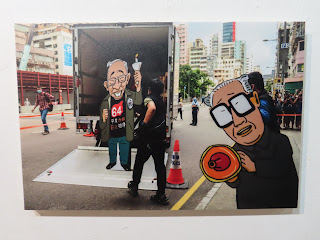
One of the photos on display at an exhibition I went to this afternoon
 
I went to lunch over on "the Dark Side" today.  This is a nickname that Hong Kong expats (who stereotypically live on Hong Kong Island -- and are also are more likely to live on Lamma Island or Discovery Bay than Kowloonside -- have for Kowloon.
 
Along the way, I passed by the building that used to house the June 4th Museum that was dedicated to keeping the memory of the Tiananmen Square Massacre of June 4th, 1989, alive, and which was pressured to close and then was raided by the police in September 2021.  Incidentally, a cavernous cinema known as the Dynasty Theatre used to be located nearby.  I say "used to be" because where the 1,920 capacity screening venue was is curently a building site.  
 
Also previously located in the area was the China Cafe, an atmospheric cha chaan teng that was the location for a number of Milkyway Image movies (including, most famously, PTU).  I have to say that I didn't have the heart to go and see what's now in its place.

After lunch (at a popular eatery that's announced that it will be closing sometime next month -- but hopefully will be reopening at another location), I headed over to check out an exhibition put on by the Hong Kong Press Photographers Association.  Entitled Focus on the Frontline 2021, it comprises prize-winning photographs from journalists who covered a range of events including sporting ones (such as the 2021 Tokyo Olympics) and also those which were darker in nature.  These included the stabbing of a policeman outside the Causeway Bay SOGO on July 1st, 2021, by a man who subsequently killed himself, and also a number that turned out to be related to the commemoration of the Tiananmen Square Massacre here in Hong Kong.

More specifically, there's a photo showing the police loading confiscated June 4th Museum items (that included a cardboard cutout of the late pro-democracy activist-politician and chairman of the Hong Kong Alliance in Support of Patriotic Democratic Movements of China, Szeto Wah, holding a commerative candle in his hand).  There also are photos showing the dismantling and removal of the Pillar of Shame from its previously prominent location at the University of Hong Kong's campus
 
On display at the exhibition too is a photo of Chow Hang-tung, the lawyer-activist who is actively seeking to keep the flame of the Hong Kong Alliance and the right of people to commemorate the Tianamen Square Massacre in Hong Kong alive even while fighting for her own freedom (and against Hong Kong government efforts to keep her in prison for many years to come).  Seeing the image of her with her inflatable bed in her office really hammers home how dedicated and committed to the cause she is, and has been for years now.

A blurb for the exhibition includes the following paragraphs:

In the past few years, the social and media environment in Hong Kong has undergone tremendous changes. Several influential mainstream media and online media have suddenly ceased operations. Become a freelance photographer.

However, while facing the changes, the photographers still only stayed at their posts until the last moment, shooting wonderful news works with historical significance, and witnessing the transformation of the city together with the citizens.

Some of the photographs give one a real sense of the yeoman efforts and work of Hong Kong's press photographers.  Truly, there are times when I think that they (along with many a journalist, editor (like former Stand News chief editor, Chung Pui-kuen  and publisher (notably Next Digital's Jimmy Lai) truly have been pretty heroic; with many of them going beyond the call of duty to make sure people see what's been going on in the world of Hong Kongers.

I also got the sense from the exhibition that many of the photographs were of people that the photojournalists and/or curators of the exhibition respect and admire, and consider heroes too.   These include Olympians who've brought glory to Hong Kong, notably fencer Edgar Cheung Ka-long and swimmer Siobhan Haughey, and also the likes of singer-activist (and former 612 Humanitarian Relief Fund trustee) Denise Ho and filmmaker Kiwi Chow. 

More re Kiwi Chow: his protest documentary, Revolution of Our Times, may never be allowed to be screened in cinemas in Hong Kong but his latest effort, a Chinese New Year comedy entitled Say I Do To Me(!), is scheduled to play in local cinemas over the festive period (and beyond).  And for those who didn't realize: yes, he has remained in Hong Kong all this time.  And it's good to see that he -- and the likes of the similarly openly pro-democracy Anthony Wong Chau-sang -- still are able to find work and an audience in their home city... which may be down and facing dark times but really ought not to be counted out (just yet)!

Friday, October 21, 2022

A Victoria Harbourfront walk that revealed Hong Kong's beauty but also some of its woes :S (Photo-essay)

This has been one of those weeks where a number of actions by the Hong Kong government have got me all hot and bothered.  (I don't want to go into detail, as I've already emoted quite a bit on (other) social media.  So will just name them here as John Lee's policy address on Wedneday and the Batman movie shenanigans today.)  And so angry did so many aspects of John Lee's policy address make me, in fact, that I felt an urgent need to get some fresh air and burn off some of my anger with some exercise.  
 
Fortunately, the weather gods made it so that the physical conditions were pretty ideal to do just that, with temperatures that got me thinking autumn's finally here and welcome breezes besides.  So off I went for an afternoon walk that took me from Fortress Hill to Central that was primarily along the Victoria Harbourfront, including "The Revitalised Typhoon Shelter Precinct" that I've been visiting long before it got "revitalised" and given that name!  
 
Along the way, I saw sights that reaffirmed my belief that Hong Kong really is beautiful but there also were some that revealed the bad things that have happened, and is happening, to this city that I've come to call home.  Regardless, the walk got me realizing that I continue to really f**king love Hong Kong and that even while the sun is setting over it, I remain loath to leave it still...
 
I enjoy spotting birds on my Victoria Harbourfront walks,
and often am rewarded when in the vicinity of the
Causeway Bay Typhoon Shelter :)
 
I can see this stepped section of the "revitalised precinct"
becoming popular place to hang out and take in the sights :)

The police going around and randomly checking people's IDs 
is something that has been happening way too often 
for my liking in Hong Kong these days :(
 
View of Central that's dominated by the building
that many people recognize from its appearance in
Hong Kong: home to both a People's Liberation Army 
garrison and Bank of America Tower, and where ads
for life insurance and events beloved by the Chinese
Communist Party adorn the landscape!
 

Okay, deep breath, try to see and appreciate 
the bright spots amidst the gloom!
 
Also, as this image from earlier in the walk seems to emphasize:
Life goes on, and we will continue to make our way through
it, with more than one way available to do so!

Wednesday, July 6, 2022

In appreciation of Alex Law and Ni Kuang

A part of Hong Kong I will forever associate with
Alex Law and his Echoes of the Rainbow
 
This past long weekend was not a happy one in Hong Kong; beginning as it did with the 25th anniversary of an event that many Hong Kongers didn't want to happen, the visit of a political leader few Hong Kongers have much affection for, the assumption of office of a new local leader who few folks have any confidence will lead Hong Kong to better days and a typhoon coming close enough to the territory to merit the raising of the T8 warning signal.  And hours after the typhoon warning signals were lifted, came news of the deaths of two men whose works have loomed much in the imagination of Hong Kong and beyond.
 
Filmmaker Alex Law passed away on Sunday at the age of 69.  Together with as well as separate from his life partner, Mabel Cheung, he had been involved in the making of a number of movies beloved by Hong Kongers (and Hong Kong film fans outside of the city).  His first film credit was as scriptwriter for The Illegal Immigrant (1985), which Mabel Cheung directed.  Other cinematic works that the pair worked on together include Eight Taels of Gold (1989), The Soong Sisters (1997) and City of Glass (2001), which he scripted and she directed.  There's also Painted Faces (1988), which they co-scripted and he directed, and Echoes of the Rainbow (2010), which she produced and he directed. 
 
I'll be honest: Alex Law is not in my list of top five (or even 10) favorite Hong Kong filmmakers.  Ditto re Mabel Cheung.  At the same time though, I do respect their work.  It's also true enough that they are two of the filmmakers I most definitely associate with this city -- and I think it'd be fair to say that they have made significant contributions to Hong Kong's cultural heritage as well as cinematic terrain.
 
Indeed, I actually find myself thinking of two of their films whenever I am in certain parts of Hong Kong.  Specifically, their beautifully shot City of Glass is one of those movies that come to mind when I've walked on the campus of the University of Hong Kong, their alma mater which it is a homage to; while every time I pass by or along Wing Lee Street, I find myself marvelling at how the old buildings along it were effectively "saved" by the Law helmed Echoes of the Rainbow.    
 
Coming hours after news came of Law's passing, the announcement of the death of novelist-scriptwriter Ni Kuang was quite the hammer blow.  The 87 year old was beloved and respected for many reasons.  For Chinese literature lovers, he was a martial arts and sci-fi novelist par excellence.  For Hong Kong movie fans, there's the fact of his having had over 220 scriptwriting credits, including a plethora of Shaw Brothers classics directed by the likes of Chang Cheh and Chor Yuen (who also passed away earlier this year), and films starring Bruce Lee.  

Ni Kuang also was respected and remembered for being a fierce critic of the Chinese Communist Party (CCP) who once said that that China’s people would continue suffering as long as the CCP remains in existence.  And in the wake of his passing, China Heritage reprinted an August 2019 piece of theirs on him which contains the following statements by Ni Kuang:   
What’s happening to Hong Kong is exactly like what happened to Tibet when it signed the ‘Agreement on Measures for the Peaceful Liberation of Tibet’ [under duress on 23 May 1951]. The Communists say the nicest possible things and then act in the most reprehensible manner. This has always been the way of the Communist Party...

‘[The Hong Kong police] put their fearless power on full display when repressing the protesters. It’s just that when their presence has really been needed — when you need police valour [as when triad gang members attacked protesters and others on the evening of 21 July at Yuen Long] there’s no sign of them. But that’s exactly when you need to hear from them. However, at least according to the news reports I’ve seen on TV, they come charging out in valorous formation when there is hardly anyone around. Who are they putting the show on for?’

Fight on, fear no sacrifice and overcome all obstacles.

 (Note: the last is Ni Kuang's reworking of a Mao Zedong slogan: "Be resolute, fear no sacrifice, overcome all obstacles and difficulties and fight on to victory"!)

Saturday, December 19, 2020

Adding brightness and color to one's day at Sai Ying Pun's Art Lane (Photo-essay)

 “On the day-to-day, things are okay- if you avoid reading the news.”  That's what a Hong Konger told a friend living in San Francisco when the latter asked her what it's like living in Hong Kong these days.  As far as I am concerned though, I find it impossible to avoid reading the news.  In fact, I make it a point to do so at various points in the day, and from a number -- and wide variety -- of sources too (including blogs such as those at The Fragrant Harbour and The Big Lychee).  This in spite there being so many days when the bad news can feel relentless and so hard to take.
 
If truth be told, there are days when things can feel so bad that I don't want to get out of bed when I wake up in the morning.  At the same time, I thus far have managed to eventually force myself out of bed even when I've been in a dark mood -- and, after doing so, I find it helps a lot to get out of my apartment to do such as go meet up with a friend, have a good meal or just go for a walk in the city or hike out in the countryside.  
 
Earlier this week, I met up with a friend for a meal and then decided to walk for a bit before heading home.  Not too far away from the China Liason Office, in whose vicinity I've been to on a number of occasions, I stumbled into Art Lane (which actually is more than one lane). A cultural project initiated by a property developer which actually works (or, at the very least, looks pretty cool and colorful), coming across it actually helped brighten my day; this not least because it served to remind me that there's still so much of -- and to -- Hong Kong to "discover" and appreciate...
 
The vision that greets you on one side of one of 
the entryways to Art Lane
 
A very different scene on the other side of the same entryway
 
Even the steps are artistic canvas here :)
 
Ditto re pipes, not just the walls... :b
 
Also, in some cases, doors and door grills!
 
A two storey high mural

I guess it was inevitable that this space would attract
the attention of at least one film crew ;)
 
Continuing on a film note: it was cool to see a Hong Kong 
film icon getting represented there -- and it just had to be
Bruce Lee, despite Henderson Land being "blue"! ;b

Monday, April 22, 2019

Getting that "It's like I'm in a Hong Kong movie" feeling at Fung Wing Kee Hotpot Restaurant

A place that looks like it could figure in a horror movie
but actually was in a Hong Kong crime drama ;D
 
The restaurant which occupies the street level space
of those three tong lau is a hotpot specialist ;b
 
And it's customary to finish a meal at this restaurant with 
instant noodles cooked in the eatery's signature satay sauce soup! :O
 
As regular readers of this blog will know, I'm a film fan whose love of Hong Kong cinema can approach geek levelsI'm also am a bit of a foodie.  And when I have managed to combine both these passions (by doing such as eating something I got to wanting to try after seeing it featured in a movie -- like in the case of fugu shirako -- or by dining at an eatery which served as a movie location), the experiences are often pretty special to my mind.

So when a fellow Hong Kong movie fan friend told me the identity of the hotpot restaurant which figures in the opening scenes of Johnnie To's PTU and of its continued existence (something which can't be assumed -- since so many famous eateries cum movie locations, such as the restaurant associated with Wong Kar Wai's In the Mood of Love are no more), I immediately contacted a few friends to see if they were up for going there some time.  (A note for those who are wondering: There are eateries where I'm perfectly happy to dine alone but when it comes to hotpot restaurants, one needs dining companions to properly enjoy eating at the place!)             

The Fung Wing Kee Hotpot Restaurant was heaving with customers the night that two friends and I made it out to that Kowloon City dining establishment, so I'm really glad that we pre-booked our table a couple of weeks in advance.  Famed in real life for its satay sauce soup option (with the thing to do being to end a meal there with instant noodles dipped in that salty brown brew!), it's pretty old school in terms of its culinary offerings and also its atmosphere -- and thus not for everyone, particularly those with more refined tastes and tendencies!
 
If truth be told, my two friends -- one of whom is a fellow film fan cum foodie, the other far more of a foodie than film fan -- whom I went there with were not too impressed with the food on offer  In particular, we all didn't care much for the beef that was supposed to be the restaurant's forte -- and it was rather disappointing that the most expensive dish we ordered also turned out to be one that we ended up not feeling like finishing since the meat turned out to be tougher than we had expected as well as hoped would be the case.
 
On a more positive note: we did find the seafood we ordered surprisingly fresh and tasty, and the vegetable options were respectable.  Still, what made me happiest over the course of our dinner at Fung Wing Kee Hotpot Restaurant was -- you guessed it! --  was the "It's like I'm in a Hong Kong movie!" feeling that the place gave me -- and not just because it's an actual famous movie location but also because it's the kind of old school place that Hong Kong movies made me nostalgic for even though I actually have spent most of my life outside of the Big Lychee! ;b

Sunday, April 14, 2019

An urban park that I've grown to like a lot, maybe even love ;b

View from a cool section of Hong Kong Park

A veritable oasis in Admiralty :)

When I was a tourist to Hong Kong -- rather than the permanent resident that I now am -- I never thought to go and visit Hong Kong Park.  And for more than a year after I moved to this part of the world, I didn't set foot even once in this spacious urban park in Admiralty whose wonders aren't all that visible when you're outside of it.  

Slowly but surely though, this well-planned public space has come to occupy a place in my heart.  And it's not just the special facilities such as its walk-through aviary or 1,400 square meter conservatory that I've found myself repeatedly returning to visit.  Rather, I've also come to seriously appreciate how relaxing it can be to walk along its paths that take one close to ponds full of lotus plants, tortoises, koi and frogs (the last of which are often heard but not as often spotted) and waterfalls that may be artificial in nature, yet whose sights and sounds can have the kind of calming effect on me that I get when I hike in the more natural environs of Hong Kong's country parks.    

So much have I come to like -- and maybe love might not be too strong a word! -- Hong Kong Park that I now have taken to taking friends and other folks visiting the Big Lychee to this urban oasis, particularly those unable -- due to time constraints or some other factor -- from spending time in the territory's country parks.  Almost without fail, it's proven to be a hit with the visitors; and this especially with those individuals who have been in Hong Kong for a few days and had rushed themselves off their feet trying to adjust to the quick pace of life here as well as felt stressed by the crowd density in the parts of the territory that tourists and people here for a conference or other type of business trip usually stay within.

For my part, there's one additional reason why Hong Kong Park feels special: that is, certain areas recognizably served as filming locations for movies that I've seen and liked, including Dante Lam's The Beast Stalker (which was my second favorite Hong Kong movie of 2008).  So, there are times when I feel like I'm in a movie while I'm in the park -- and perhaps none more so than on my recent visit there last month when a friend and I got to belatedly realizing that acting legend Lisa Lu was right behind as as we made our way to the branch of the Lock Cha Tea House located within Hong Kong Park and, as we sipped tea and chatted in one corner of the facility, filmed what appeared to be a TV interview in another section of the establishment! ;b

Tuesday, March 12, 2019

A short visit to Phang Nga, home to much greenery and interesting geology

Two geological formations in Phang Nga 
that are said to resemble elephants
 
A part of me wanted to get on a boat and get closer
to those limestone formations
 
View from a cool cave on a super hot day
 
On my first full day in Phuket, I went on a car journey that allowed me to see more of it than just the area around Surin beach and also took me off the island for a few blessed hours.  More specifically, I was driven over to Phang Nga, a neighboring province I could see was greener and filled with interesting geological formations even while the car was travelling along the 660-meter-long Sarasin Bridge which connects Phuket and the Thai mainland!
 

In any event, I got to see the pair of geological formations that Phang Nga is said by at least one local source to have got its name.  I also got to see a number of other eye-catching limestone formations in my short time there -- but, alas, did not get to see perhaps the most internationally famous of them all: that which has come to be popularly known as James Bond Island thanks to it having appeared as 007 antagonist Scaramanga's hideout in The Man with the Golden Gun.

Before this recent Thailand trip, I had read about boat tours that could be taken from both Phuket island and the Phang Nga mainland that would get you close to James Bond Island.  Not being that great a fan of James Bond (and not having seen the 1974 James Bond film for which it was a movie location), I didn't bother to look too closely into doing so.  And even while the island does look pretty stunning in pictures, I'm glad I didn't book a boat tour when I was in the area as it really was hellishly hot for much of the time that I was there.
 
Still, this is not to say that I didn't get out of the air-conditioned comfort of the car I was being ferried around in to get up close to any cool geological features during my brief visit to Phang Nga.  Indeed, as it turned out, my primary reason for heading over to this part of Thailand was to check out a trio of connected caves, all of which were blessedly cooler temperature wise than the outdoor areas exposed to the harsh, unforgivingly bright sun that shone pretty much all day that day!      

Tuesday, December 25, 2018

Christmas Day hike in Ma On Shan Country Park :)

A world away from the Hong Kong most people (think they) know
 
Luk Chau Shan's Canoe Rock
 
An old (and, it looks like, ruined) church that I think
has appeared in more than one Hong Kong movie
 
It's been a while since I've gone on two hikes in three days.  It's also been a while since I've gone up to the Ngong Ping plateau located in Ma On Shan Country Park (and, for that matter, the more famous Ngong Ping plateau on Lantau Island).  But two days after going in search of red leaves in Tai Lam Country Park, I went with a friend along the Ma On Shan Country Trail on what's turned out to be a surprisingly warm as well as humid Christmas Day.
 
As per my usual procedure with regards to this particular hiking trail, we started our trek from near Mau Ping New Village near Sai Kung town and ended it in Ma On Shan town (where we caught the train back to the more densely populated section of Hong Kong by Victoria Harbour).  Where we departed from the usual is that after climbing up to the Ngong Ping plateau and spending some time taking in the always breathtaking -- even when the visibility levels are not as super high as I would like -- views from there, we decided that we had enough energy and inclination to detour off the official country trail and go up 414 meter high Luk Chau Shan in search of its famous Canoe Rock.
 
If truth be told, I found that particular rock formation to be on the underwhelming side visually when I finally caught sight of it.  However, I did enjoy the Luk Chau Shan detour since that hill is indeed home to an interesting rocky landscape quite unlike the nearby Ngong Ping plateau.  Also I must admit to some satisfaction is finally having gone up a hill I've passed by quite a few times before, often with the thought that I'd like to go up it one day!
 
In addition, as we approached the former mining village of Ma On Shan Tsuen, home in the past to some of the workers of the Ma On Shan Iron Mine which was in operation from 1906 to 1976, I also got views that I previously hadn't been privy to.  Thanks to Typhoon Mangkhut having felled quite a few trees in the area, I now got clear views of the village's old St Joseph's Chapel which, if I'm not mistaken, has appeared in a number of Hong Kong movies, including Tactical Unit -- Comrades in Arms (2008), a film in which a team of Police Tactical Unit officers get lost for a time in the wilds of Hong Kong!
 
More than incidentally, that movie had me a few hiker friends giggling with amusement when we viewed it because it showed how quite a few Hong Kongers really aren't that used to being in the Hong Kong countryside and are liable to freak out over what are some pretty common sights when one goes hiking in the Big Lychee.  And when we later came across a couple of the locations used in the film, we got to laughing even more because a number of the sections of Hong Kong they had supposedly got lost in actually are located pretty close to official hiking trails and not that far away from roads that are accessible to vehicles, never mind pedestrians! ;D