Friday, October 9, 2020

On the 102nd day since China's security law for Hong Kong came into effect

 
Protest stickers spotted on the first full day that 
 
Protest grafitti expressing a wish many still have
 
I went out for dinner and drinks last night with three friends who I've spent a good number of hours protesting out on the streets with over the past year and a half.  For our final drink of the night, we went to Club 71 to possibly have our last drinks at a famously pro-democracy watering hole -- named after the July 1st, 2003 protests -- which will call time and close at the end of this month.  
 
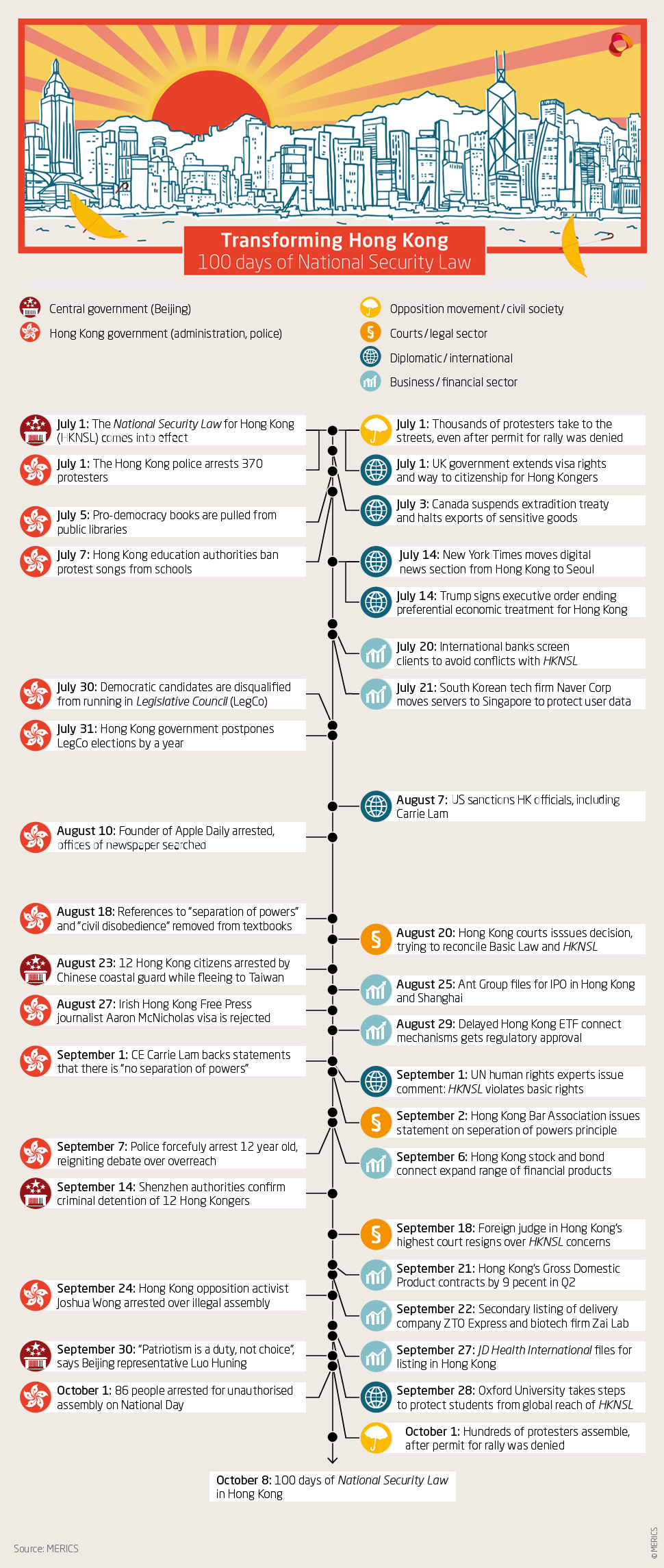
At one point in the evening, I pointed out that the day before had been the 100th day since China imposed a Security Law on Hong Kong.  My friends hadn't realized this was the case.  What we all recognized and agreed though was how much has happened to and in Hong Kong these past 100 days or so, much of which actually has been pretty scary and upsetting.      

Its proponents talk about the national security law having brought stability back to Hong Kong.  For a good many people I know though, it's more a case of the national security law (or, as someone has proposed to re-name as the anti-democracy law) having brought uncertainty as well as fear into their lives; not least by prompting a good many folks to consider uprooting themselves and families and leaving Hong Kong altogether.  
 
 
Something else I think is true in Hong Kong: many people worrying -- and having their actions dictated by -- the ongoing pandemic as well as the security law.  For example, my friends and I spent a significant amount of time discussing the Wuhan coronavirus -- and the possibility of tougher social distancing measures, including the closure of bars and limiting of hours that restaurants can be open, being reintroduced again -- last night; more so, actually, than the security law.  For even though the majority of this week's daily number of new cases have been in the single digits -- like the eight we had today -- some people are warning that the infection rate is again hitting a worrying level again and that further anti-Wuhan coronavirus measures need to be considered.
 
Alternatively, even while the security law most certainly has encouraged self-censorship (including by the press), I get the feeling that a number of individuals and businesses have returned to expressing their political opinions and such again in recent weeks.  For example, some of those restaurants which removed protest art and signs from their walls back in late June and early July have found new ways to advertise their pro-democracy credentials: including by putting ads in Apple Daily or by buying copies of the newspaper and prominently displaying them in their establishments (and availing them to their customers to read).       
 
I've also been heartened to see the return to Twitter action of two individuals who pro-Beijingers looked to have sought to silence.  If truth be told, Kong Tsung-gan is still less active than I'd like but I give him credit for his making the effort to Tweet last month in support of People Power vice-chairman Tam Tak-chi.  At the same time, I truly appreciate that even though he's been effectively driven out of Hong Kong (by way of his being denied a new work permit in order to take up an editorship at Hong Kong Free Press), Aaron Mc Nicholas is continuing to Tweet about Hong Kong matters.  
 
As a matter of fact, it was a series of Tweets by him that alerted me to this recently past Thursdsay having been the 100th day; the following of which are excerpts from them:- 
THREAD: It's been 100 days since the national security law took effect in Hong Kong on June 30, 2020. Since the legal text had not been published in advance, nobody knew for sure whether it would only target violent behaviour, which was the stated rationale for its introduction.   

The next day, we learned that it was intended to target non-violent behaviour also, as the first person arrested under the law was a protester with a Hong Kong independence flag...

...despite all that we will not know for years, the international impact has been felt already. Extradition treaties have been suspended, asylum applications have been granted, co-operation with data requests have been paused and relocation decisions are being made. 

In the wake of that last quoted paragraph: does this sound like the national security law has brought stability back to Hong Kong to you?!  

Tuesday, October 6, 2020

Continued political shenanigans half a world away from the USA

 
An increasingly chained and locked city...
 
...but, try as they might, they have not (yet) wiped out all resistance
 
Over the past week or so, the big news as far as much of the world has been concerned has involved goings on in the USA rather than in places like Hong Kong.  Sure, there were protests in Hong Kong on October 1st (China's National Day) and arrests of protestors.  But all this paled in comparison to the bombshell news of Donald Trump testing positive for the Wuhan coronavirus on October 2nd and the ensuing -- and still ongoing -- shenanigans involving the individual who, by way of his position, is the most powerful person on the planet.    

Upon hearing the news of what was happening half a world away, I must admit that one of my first thoughts was: I hope the powers that be over in Beijing don't decide that this would be a good time to attack, even invade, Taiwan.  Touch wood but that has not happened thus far.  For that matter, there have been no major arrests made or moves to further curb freedoms in Hong Kong in recent days.
 
Still, this doesn't mean that nothing of note has happened lately.  For example, there have been more revelations with regards to the case of the 12 Hong Kongers whose unsuccessful attempt to flee to Taiwan back on August 23rd has resulted in there detention over in Mainland China for more than one month now.  More specifically, Apple Daily has reported that a Hong Kong Government Flying Service plane had been monitoring the speedboat that the 12 fugitives were on; increasing suspicion -- which Carrie Lam herself has been unable to dispell -- that the Hong Kong government had cooperated, even alerted, the Mainland Chinese authorities about the 12 Hong Kongers' actions and thus played no small part in their capture.   

 
I guess the super optimistic derive some hope from the likes of Alexandra Wong having managed to pass through the system and be able to return to Hong Kong.  But I must admit to looking at the example of the Causeway Bay Books booksellers and dwelling far more on the fate of Gui Minhai, sentenced to imprisonment for 10 years (and seemingly forgotten by a good many Hong Kongers) than Lam Wing-kee, who now has embarked on a new life in Taiwan.    
 
Also concerning to me is what's continuing to happen in Hong Kong itself.  Among other things, yesterday saw the official announcement of a teacher's deregistration for using pro-independence materials in class, reportedly to teach students about the concepts of freedom of speech and independence.  After China imposed a security law on Hong Kong, you just knew that the authorities would be cracking down on the education front.  Heck, there was a sense that the authorities were gunning for the educators and students even before then -- and I don't just mean literally (as was the case at Hong Kong Chinese University and Hong Kong Polytechnic University last November).     
 
 
A parent whose child was taught by the deregistered teacher was quoted as saying: "I went through the worksheet last night. I personally don’t think there’s any problem with it as there isn’t any premise for a pro-independence answer".  Understandably, then, "as a parent, I feel pity and regret for such a good teacher. We feel sad about that".  
 
This case also got me thinking back to a piece in The Guardian a few days ago about those who have decided to leave Hong Kong in the three months since the security law came into effect.  In particular, I think of the mother who stated that she had "lost faith in the political system and worries her child will become indoctrinated in the education system officials have vowed to overhaul under the national security law."  This surely is the kind of thing that she has been worrying about -- for her child and also her Hong Kong. :(    

Saturday, October 3, 2020

Fond memories of a visit to Okunoshima, Japan's Rabbit Island (Photo-essay)

We're having a long weekend in Hong Kong courtesy of two public holidays having fallen this past Thursday.  In normal times, this would have resulted in lots of Hong Kongers flying out for a short holiday somewhere -- with Japan and Taiwan being super popular holiday destinations.  But, as we've long established, 2020 has been a pretty crazy year from the get go through to this week.  
 
With Hong Kong's third Wuhan coronavius wave now under control -- as can be seen by the past two days having seen single daily new case numbers (4 today -- only one of which is a local transmission -- and 7 yesterday) and only one of Thursday's 10 cases having been a local tranmission -- talk is turning once more to the setting up of "travel bubbles".  In the meantime, here's sharing my first photo-essay of the most recent Japan trip I took: back in October of last year.  
 
Despite it having taken place in (already) troubled times, I did manage to find some peaceful respite while in the Land of the Rising Sun -- this even though I actually spent time in certain parts of the country that actually have dark pasts!  As unlikely as it may seem, visits to such locales can give one hope for a better future, and that all this, too, shall pass one day...        
 
Passengers eagerly anticipating getting off the ferry and
 spending time on the Seto Inland Sea isle of Okunoshima
 
A fair denizen of what has become 
popularly known.as Rabbit Island! :)
 
Yes, Okunoshima's main attractions is its rabbit population
(who are most definitely unafraid of humans)!
 
Puppet Ponyo wishes for it to be pointed out that
there's more to Okunoshima than just rabbits though
 
On a stroll around the island, one is privy to some really 
gorgeous views of the Seto Inland Sea and neighboring islands
 
I didn't go into the beautifully clear water but I was 
unable to resist sticking a hand into it :b
 
Considering its principally kawaii associations these days, it can come 
as a quite the shock to realize that Okunoshima was where thousands 
 
These days though, one is far more likely to see the gentle side 
of Japan on a visit -- with the apparent biggest danger there 
involving people wanting to cuddle the actually feral rabbits 
(and there consequently being signs asking people not to do so!)

Thursday, October 1, 2020

The Hong Kong spirit of protest remains alive on China's National Day!

 
How do people protest when the police are clamping down 
hard on those they perceive are trying to do so?
 
Against the odds, people find ways
 
Happy Mid-Autumn Festival to you! :)
 
 
I guess it's understandable that the authorities didn't want a repeat of last October 1st, when what happened in Hong Kong proved to be quite the international embarassment for the Chinese government.  But the way they went at things, it was clear that they wouldn't even tolerate any peaceful protests of the kind that used to take place in Hong Kong not so long ago -- like even just two or three years ago.       
 
Denied the opportunity to (legally) walk on the streets of Causeway Bay and Wan Chai this year, I decided to walk in those areas this afternoon anyway -- just on the pavement, where one still legally is allowed to be on.  In less than a couple of hours of strolling, I came across nine police cordons.  Happily, I was allowed to pass through all of them without much incident.  But I witnessed a number of people -- most of them young adults, not all of them dressed in black -- getting stopped and searched at all of those nine cordons; occurrences that I find disturbing even when it doesn't happen to me.   

Over the course of my walk, I occasionally heard people shouting protest slogans such as "Five demands; not one less", "Fight for freedom; stand with Hong Kong" and even "Liberate Hong Kong, revolution of our times" (the last of which has been declared illegal under China's security law for Hong Kong).  I also heard curses hurled at the police when they were within shouting distance.  And I also saw other signs of resistance such as protest stickers and, pretty amusingly to my mind, people reading copies of Apple Daily while strolling leisurely about the place as well as while standing around!       
 
 
Another online call that does appear to have gotten pretty good participation today was that involving hiking up Lion Rock this evening, producing visuals reminiscent of when we had the Hong Kong Way on August 23rd last year and Lion Rock was lit up by protestor torchlights!  The fact that a good number of people managed to make it up a quite formidable peak not only in darkness (unless they got up there earlier than I thought) but also only after braving police attention and intimidation says so much about the Hong Kong protest spirit -- which is not only alive but also strong!  

Wednesday, September 30, 2020

Musings about mooncakes, Catholics and more on Mid-Autumn Festival eve

  
October 1st is China's National Day
 
This year, October 1st is also Mid-Autumn (aka Mooncake) Festival!
 
Despite it still feeling like summer weather-wise, today is the eve of the Mid-Autumn Festival.  As can be discerned from its alternative names, this festival is also associated with mooncakes, moon viewing and lantern displays.  It's also associated with family reunions, with many families making a point to gather together to have dinner together on the festival's eve. 
 
 
Beginning in 2010, Joseph, Cardinal Zen would deliver mooncakes to prisoners during the Mid-Autumn Festival.  This year, though, Hong Kong's Bishop Emeritus has been barred from doing so; with the authorities having deemed mooncakes to be political weapons and the donation of them to prisoners a political activity.  Such is the heightened paranoia and absurdities that have come to be the norm in Hong Kong in the wake of China's introduction of the security law to Hong Kong.  
 
Another disappointment that the 88-year-old cardinal has had to deal with recently came after he flew to Rome to seek an audience with Pope Francis but the Pontiff decided against allocating any time to meeting with him.  That U.S. Secretary of State Mike Pompeo also was denied a meeting with the Pope is no comfort; particularly as both Cardinal Zen and Pompeo shared the intent of voicing their concerns to the Pope about what's happening in Hong Kong (along with in Mainland China).       
 
 
Is it because Hong Kong Chief Executive Carrie Lam is Catholic?  If so, so are prominent advocates for Hong Kong's freedoms and bid for democracy such as Jimmy Lai and Martin Lee as well as Cardinal Zen.  More likely, it is Pope Francis feeling willing to sacrifice Hong Kong (with its Catholic community) along with the Muslim Uighurs and Buddhist Tibetans to cement a deal with the Chinese authorities; something that gets me thinking that he may be the modern day Pope Pius XII (AKA Hitler's Pope).
 
People looking from outside of Hong Kong may not think things are that bad in the territory.  As HK Wuliff, a Hong Konger whose musings and observations I often connect with, Tweeted back on August 1st: "yeah, we still have internet. we still get to go on youtube. we can go shopping. for a few days we almost lost restaurants but we have that back, now. we can still go to work and school and we’re still alive."  But also in the same thread can be found the following remarks: "it’s actually so insane how quickly HK descended into this state. imagine explaining to an acquaintance that in the space of one month, you’ve lost all political freedom and are now living in a city where dissent is punishable - actually punishable - by life in prison". 


Monday, September 28, 2020

Looking back to the start of the Umbrella Movement and ahead to there being continued protests in Hong Kong

How Harcourt Road looks on protest-less days
 

Admiralty is definitely more colorful when occupied by 
pro-democracy protestors and decorated with their creative works!

Six years ago today, what came to be known as the Umbrella Movement (or Umbrella Revolution) began in earnest after the police fired what was then an unprecedentedly large amount of tear gas into a protest crowd assembled at Admiralty.  I don't expect any tear gas to be fired today or to see water cannons going into action in the area, as was the case one year ago.  But make no mistake: the pro-democracy protest spirit that emerged on September 28th, 2014, has by no means been extinguished.  This even though the authorities have been doing what they can to bring Hong Kong to heel.  
 
Take, as an example, the banning of a protest march intended to take place this upcoming October 1st (with an appeal against the decision having proved unsuccessful).   As expected, the police cited public safety fears by way of the Wuhan coronavirus.  This is despite the third wave now being under control: as evidenced by there just being 10 new cases today; of which only 3 are local transmissions, all of which are linked to other ones.  And you also had the proposed march's very experienced organizers also indicating that social distancing measures could easily be practiced, such as asking marchers to wear masks and walk in groups of no more than four, the maximum number of people allowed to gather under regulations.    
 
As Renaud Haccart Tweeted back on September 15th: "As noted by other commentators, there’s a fair chance that group gathering rules will be the very last to go, as they provide the perfect cover for police to disrupt any public protest of any size or form and make arrests."  And it really didn't seem purely  coincidental that one week later, the powers that be proceeded to extend the current coronavirus social distancing measures until October 1st, amid online calls for a protest march on that day.
 
As a reminder: even without there being the Wuhan coronavirus attacking much of the world, the October 1st protest was banned last year.  And the ban not withstanding, tens (if not hundreds) of thousands of Hong Kongers went out onto the streets to protest nonetheless; and, in so doing, produced the kind of visuals that the authorities most certainly did not wish to have beamed out to the world on China's National Day.
 
It's not entirely impossible that a good number of people will elect to march in protest again this October 1st.  This despite anti-Wuhan coronavirus social distancing measures being in effect -- and the vague, broad and sweeping security law China imposed on Hong Kong on June 30th whose penalties include life imprisonment.  
 
Alternatively, it's been suggested that people wear black on the day to register that October 1st is a day of mourning, not celebration, for most Hong Kongers as well as a sign of solidarity with the 12 Hong Kongers whose bid to seek asylum and freedom in Taiwan led instead to their detention in Shenzhen.  I do sincerely hope though that people won't dress up in black if they do plan to go onto the streets to protest because black attire has become the equivalent to the Hong Kong police of red cloth to bulls!    
 
For those who are wondering why Hong Kong is such a city of protest: do realize that one big reason why this is so is because Hong Kong has never been fully or really democratic.  Consequently, Hong Kongers have had to find other ways to make our will be known and heeded; with mass protests having met with some notable success in the past (e.g., in 2003 and 2012).           

And for those who reckon they know about the security law that's been imposed on Hong Kong: do give the quiz by The Guardian a try.  In what loos to have been an effort to commemorate the start of the Umbrella Movement (even without outright stating it), that British newspaper has shone the spotlight today on: Hong Kong's "freedom swimmers" (the hundreds of thousands of Mainland Chinese who escaped to Hong Kong between 1950 and 1980);  the Chinese Communist Party faithful shipped in to carry out Beijing's will in Hong Kong this year; and Oxford University's efforts to protect the students of China in the wake of the coming into being of China's security law for Hong Kong.  

Saturday, September 26, 2020

Hong Kong remains far more threatened by political repression than the Wuhan coronavirus or nature in general


Playgrounds have been reopened for use this week (but have 
children gotten out of the habit of visiting them after so long?)

A rare tornado was spotted near Hong Kong International Airport yesterday afternoon.  Also, a wild boar family decided to head to Central and were recorded swimming in the pond of the Bank of China Tower.  It used to be that such events (along with, less amusingly, hiker deaths) would be the biggest news of the day when they occured in Hong Kong.  And in some ways, it's kind of quaint and assuring that they still can make the news these days.
 
But of course, these days, what tends to grab more attention is news concerning the Wuhan coronavirus or something political (which can range from political arrests to the enactment of a draconian law).  Re the former: at a time when things are looking really bad again on the pandemic front in many parts of the world (including Europe and Indonesia rather than just the U.S.A.), it can make for a nice surprise that Hong Kong has managed to bring its third wave under control; with there having been just two new cases yesterday and one today.      

As an added bonus: today's single new daily Wuhan coronavirus case was an import rather than local transmission; the second time this month that Hong Kong has reported no local cases.  For good measure: it's also the case that Hong Kong has only had one day this past week with an unsourced case.  All things considering then, there's actually plenty to feel good about on the pandemic combatting front here at this point in time.  So it surely is understandable that there are calls to reopen the still-closed-off beaches and to ease the gathering bans (the latter of which is impossible to not think are just an excuse to ban political vigils, rallies and marches -- like the one that usually takes place on October 1st); this particularly when it's allowed and normal again for such as MTR carriages to be super packed!
 
On the political front: there may have been more security law arrests -- this time involving a mother and her son accused of selling weapons online.  Upon further examination though, there are aspects of the case that appear questionable.  For one thing, the mentioned weapons are things like air guns, a bulletproof vest and respirators.  For another, whether the case actually falls under the security law is something that the police appear uncertain apart; this not least because the offensive materials (i.e., materials calling for Hong Kong independence) were found in the suspects' home (rather than, say, displayed in public by them)!      

As things presently stand, the man arrested has been charged and denied bail but his mother was not charged and released on bail.  I haven't seen any explanation for their unequal treatment.  What I have read though is that the man's lawyer has alleged that his client was intimidated by the police into making making incriminatory statements against himself.  So it's entirely possible that when the case finally gets to court, the judge will dismiss it or acquit the accused due to faulty evidence or such like once more.  (Though, of course, the possibility also exists that one will encounter a judge more willing to take the side of the government -- for they do very much exist.)   
 
Looking beyond Hong Kong: some signs are appearing that the international community may belatedly be waking up to the China threat; in view of its actions in and towards Hong Kong and Taiwan as well as Tibet and Xinjiang.  With regards to Hong Kong: I found the following statements attributed to Miles Yu, a member of U.S. Secretary of State Mike Pompeo's policy planning staff, in a recent Voice of America article to be pretty spot on:     
Hong Kong has provided the world with a measuring stick to assess Beijing's behavior since 1984, when a deal was struck to return the territory to Chinese sovereignty on the condition that it enjoy a high degree of autonomy for 50 years. The actual handover took place in 1997. 

Hong Kong is "first and foremost a promise... It's a promise of a high degree of autonomy for 50 years — judicial independence, free press, individual liberty, rule of law." 

What the world has witnessed... is a promise made and a promise broken. 

"You might say it has been broken in a very brutal and semi-fascist way."

And I do hope that he's right when he said more countries are coming to recognize that China poses a threat to everyone; this not least since the deadly coronavirus unleashed in Wuhan less than a year ago has gone on to cause so many deaths in the world already, with many more expected to come.