Sunday, May 15, 2022

Much to see in Hagi's old castle grounds despite the castle having been long ruined! (Photo-essay)

Yesterday came startling news that China had withdrawn from hosting the Asian Football Confederation's Asian Cup because of Covid issues -- startling because that tournament's not due to take place until June of next year.  While Hong Kong is not subject to (all of) the same restrictions as Mainland China (e.g., there have not been reports of mass "clipping" of passports the way there has been over in Mainland China in recent days to prevent its citizens from travelling abroad), it does make me think and worry that Hong Kong will remain largely closed, with a minimum of one week's hotel quarantine being required upon people arriving in/returning to Hong Kong for some time to come.
 
As it is, it's quite the shock for me to realize that I've not been out of Hong Kong for some two and a half years... and, also, that I've not yet finished blogging about my most recent trip abroad -- to Japan back in October 2019!  So here's going ahead and sharing more photos taken from that trip: this time, focusing on ones taken while exploring the old castle grounds of Hagi; the Yamaguchi prefecture city which I spent a few days in after moving my base there from Hiroshima (which has come to be one of my favorite cities in Japan; from where I had made day trips to Okunoshima (AKA Rabbit Island), Ikuchijma, Osaka (mainly for the Funassyiland there this time!) and Akiyoshido)...
 
The first photo I took of the picturesque town of Hagi outside of my hotel 
there -- of the pier for sightseeing boats which I elected not to go on!
 
Puppet Ponyo (remember her?) posing in the grounds 
 of the long-ruined Hagijo (Hagi Castle)
 
Much of the grounds have a neglected feel even though
there's a still functioning Shinto shrine located within it
 
From one side of it, there are splendid views to be had
of the Sea of Japan, the coastal section of Hagi, and 
one of those sightseeing boats whose pier I had passed by earlier 
 
A Japanese garden within the ruined castle grounds
(which are formally known as Shizuki-koen (aka Shizuki Park))
 
With so few other people about the place, the park
turned out to be great for critter spotting (including 
of this grey heron) and nature photography! :)
 
One of those large spiders that I've only ever seen 
in Japan and Hong Kong :)
 
Spotted as I was leaving the old castle grounds:is that a hawk 
or an eagle?  I know for sure though that it's a bird of prey!

Thursday, May 12, 2022

Behold the state of Hong Kong: where a 90 year old Cardinal and other trustees of a humanitarian relief fund stand accused of being national security threats!

Cardinal Joseph Zen showing support for the people,
and being cheered back in turn in the summer of 2019
 
So many terrible things have happened in Hong Kong in recent years (e.g., police attacks of pro-democracy protestors in 2019, China's imposing a national security law on Hong Kong in 2020 and the mass arrest of pro-democracy figures last year) that many people have become resigned to bad and worse developments occuring over the horizon.  Still, what happened yesterday really shocked many of us; not least because it looked to have taken the prosecution of advocates of democracy in Hong Kong to another upsetting level.
 
 
Apart from having been a professor who mentored the likes of Nathan Law (Lingnan University class of 2018), Hui also was a trustee of the 612 Humanitarian Relief Fund set up to provide humanitarian and relevant financial support to persons injured, arrested, attacked or threatened with violence during the anti-extradition bill protests (and did help a whole lot of people before it ceased operations on October 31st of last year).  And with the arrests of three other of the fund's former trustees later in the day, it became clear that the authorities had decided to go after people associated with this fund.
 
Here's the shocker: one of the fund's former trustees arrested yesterday evening was 90-year-old Cardinal Joseph Zen.  And the charge thrown at him was "conspiracy to collude with foreign powers": a national security law offence.  Tell me: In what universe -- other than Hong Kong's crazed one -- can a 90-year-old man who happens to be a Cardinal be seriously considered a national security threat?!

Here are two other shockers: the two other 612 Humanitarian Relief Fund trustees arrested yesterday were eminent lawyer Margaret Ng -- who, more than by the way, is 74 years of age -- and singer-activist Denise Ho -- whose 45th birthday it was this past Wednesday.  Granted that Margaret Ng and Denise Ho have been arrested before; but their being charged with national security crimes (along with Hui Po-keung and Cardinal Zen) takes the seriousness quotient up several notches.
 
Perhaps because they didn't want too much of an international furor around these arrests, the police released Cardinal Zen, Margaret Ng, Denise Ho and Hui Po-keung on bail late last night (rather than deny bail to them the way that it's happened to many any other person accused of having broken the national security law -- including the bulk of the 47 politicians and activists arrested for organizing or taking part in the democratic primaries of July 2020).  But do not think for even a moment that the authorities are backing off in their prosecution and persecution of people associated with the 612 Humanitarian Relief Fund. 


A comment by Samuel Bickett in the wake of this news that says so much about the situation in Hong Kong: "Among lawyers in Hong Kong, a popular topic of conversation has long been when—not if—the police state would begin imprisoning lawyers for taking on sensitive clients."  And of course people have been moved to wonder if the police also plan to go after the (tens, maybe even hundreds of) thousands of the fund's donors?!

Tuesday, May 10, 2022

Quotes that speak to me and touched my heart from Karen Cheung's The Impossible City

 
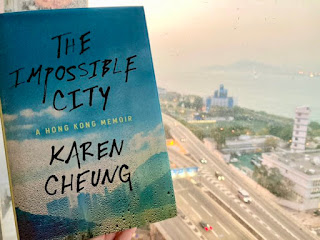
Karen Cheung's photo of her book, The Impossible City:
 
Back in February, despite the fifth coronavirus wave seriously raging in Hong Kong, I made a trip to a bookstore to get myself a copy of a book by a local author whose works I'd previously read in publications such as the Hong Kong Free Press, Mekong Review and the excellent Holmes Chan edited volume, Aftershock: Essays from Hong Kong (2020).  Karen Cheung's The Impossible City: A Hong Kong Memoir is so brilliantly evocative and thought-provoking that I decided after going through the first few chapters that I needed to slow down to savor the reading experience.  And after I finished reading it, I immediately knew that I wanted to re-read the tome and, indeed, am in the middle of doing so.

More than by the way: earlier this month, I passed the 15 year mark in terms of coming to call Hong Kong my home.  So here's going ahead and commemorating that anniversary by picking out 15 quotes that particularly speak to me from a book written by someone who, like me, was not born in the Big Lychee but has grown to f**king love Hong Kong:-
 
When I was four, my small city went from being a British colony to Chinese property.  At the time of the historic event, known as the handover, literature and media depicted Hong Kong as at the intersection of clashing identities, but the truth was worse: We had no identity. (Page viii)
 
I had bought into all the cliches that the adults told me about my city: that it was an apolitical cultural desert inhabited by go-getters who have no real values except becoming rich.  But I did not know yet that this is a place where parallel universes coexist, and you could live your entire life here without ever pulling back the curtains on the other Hong Kongs.  (Page x) 

It takes work not to simply pass through a place but instead to become part of it.  (Page xii)
 
Even before the national security law and subsequent government crackdown, Hong Kong had been a difficult place to live in, with its high rents, inaccessible mental health care, and intolerance for nonconformist arts.  This is all by design: If you could not survive here, perhaps you would never have time to make this place feel like home.  But maybe this is what it means when we say we love this place -- we recognize all of its imperfections, and still refuse to walk away.  (Page xv-xvi) 

Maybe you can't save this place; maybe it isn't even worth saving.  But for a moment, there was a sliver of what this city could have become.  And that is why we're still here.  (Page 22)

The people of Hong Kong had been stripped of the right to self-determination, with no seat at the table when the negotations for our fate took place.  You are Asia's world city, an international financial center, an inalienable part of China, the government tells us, the foreign press tells us, Beijing tells us.  But if we cannot rewrite our origin story, can we at least reimagine our future? (Page 32-33)

What is considered secession or subversion?  The crimes cover a wide spectrum, from writing a piece that criticizes the Communist Party's rule to actively plotting an assassination.  Where is the arbitrary line where something becomes illegal?  That uncertainty is the fear. (Page 91)

I remember the half million people [who protested against Article 23 on July 1st, 2003] who bought me seventeen years of freedom and delayed the inevitable.  They made it possible for me to grow up in an environment without fear.  It would have been much easier to leave, but they stayed.  They marched.  And because of them, once upon a time, we were fearless.  (Page 93)

Karen Cheung quoting Hsiuwen, a friend who's originally from Taiwan but now lives in Hong Kong: I truly want a place to call home, a place I can always go back to and feel safe at.  But this doesn't feel possible, at a moment like this.  This idea that there's a place that is 'forever' and 'un-changing' -- I don't think I can find it.  It's especially impossible in Hong Kong, given all the uncertainties.  (Page 119-120) 

Each generation has faced its own set of social problems or political turmoil and, in turn, mental health crises.  In 1989, the June 4 massacre in Beijing triggered a wave of grief in Hong Kong; in 2003, the SARS epidemic and the subsequent economic crisis led to a historically high suicide rate.  Decade after decade, the people in Hong Kong have learned to live with fresh disappointments that are more devastating than the last. (Page 174)
 
After the [2014 Umbrella M]ovement, Hong Kong identity became intertwined with political activism, especially among the younger generation.  Apolitical people are sometimes regarded as not true Hong Kongers, because only those affluent enough to leave would be able to ignore the most significant political movement in the city to date.  (Page 182) 

The narrative has always been that Hong Kong is a transitory city.  People come and go, move on in search of better lives.  I would have tried to do the same, if I had not found my people in Hong Kong. (Page 195)

Writing is not activism.  Writing about a place cannot keep it from disappearing, and writing cannot replace the work of mutual care we have to do in the communities we inhabit.  All the same, these documentations are all acts of resistance, of remembrance.  Someday, when they tell us otheriwse, we will revisit these accounts that challenge what they want us to believe.  We will know what we cannot unknow. (Page 224)

We knew that it was only a matter of time before the crackdown began.  We knew the script that the Communist Party followed.  But for a brief moment, we let ourselves believe that we could bring about change so long as we kept going. (Page 270)

Hong Kong is dead, the new law wiped out the resistance, everyone said, and yet.  Across the harbor, the lights are still on. (Page 292)

Sunday, May 8, 2022

A non-event that I'm still going to give my two cents about!

  
Hong Kong cartoonist vawongsir take on 
 
Something happened in Wan Chai this morning that has received international press coverage but feels pretty meaningless to many people in Hong Kong.  It involved John Lee, the 64-year-old ex-police chief who was Security Secretary back in 2019, who subsequently went on to be appointed Chief Secretary in Carrie Lam's cabinet last summer and now has been anointed as her successor as Chief Executive of Hong Kong.  

Officially, what took place today was a "small circle" "election".  By "small circle", I mean that only a very small number of people were given a vote in the proceedings: 1,461 to be exact; and vetted last year by the then Chief Secretary, who turned out to be the "contest"'s sole candidate.  Yes, you read it right: John Lee "ran" unopposed for Chief Executive; and, for some reason, instead of just declaring victory straight away or at the end of the nomination period, the powers that be went ahead and staged an "election" all the same -- with an allocated (and undoubtedly fully utilized) budget of HK$228 million more than 7,000 police officers (i.e., more than four times the number of this "contest"'s eligible voters) deployed today to ensure that the "election" would go as planned!
 
In view of this not being a usual "election" in so many ways, the media struggled to figure out how to actually bill today's proceedings (with the New York Times coming straight out and describing it as a "rubber-stamp election".  Then we had the (pro-Beijing) media outlets trying in vain to insert some "tension" into the "race"; with such as the South China Morning Post's attempts to do so being the subject of much ridicule in recent weeks.   
 
Two and a half hours this morning were allocated to the casting of the votes for Chief Executive.  It took even less time to get the votes counted and have John Lee declared the winner of the "contest".  Interestingly, he actually didn't get all 1,461 of the votes (despite his having pre-vetted the voters).  For some reason or other, 33 of the voters didn't turn up to cast their ballots, four voters casted blank votes and eight voters had the temerity to vote against John Lee! 


At the same time, I don't think "1416" will replace the nickname John Lee already has been saddled with: Pika-chiu (inspired by his Chinese personal name of Ka-chiu)!  Sounds kinda cuddly, right?  But, then, Carrie Lam's also known as Piglet (as well as 777) and Xi Jinping as Xinnie the Pooh -- and they're by no means thought of as cuddly or lovable at all!  And, if truth be told, John Lee seems scarier to me than Carrie Lam.  

 
He also (mistakenly) wished everyone "Happy Christmas" today. I guess it's a sign that John Lee, who only recently revealed that he's Catholic (like Carrie Lam and Hong Kong's second executive, Donald Tsang) felt that Christmas had arrived (early) for him today -- though some might be inclined to think that Carrie Lam is bequeathing him a poisoned chalice rather than bestowing upon him a great gift!

Friday, May 6, 2022

One more walk along Victoria Harbourfront that reinforces my love of Hong Kong (Photo-essay)


While I am not happy that Hong Kong remains way behind the rest of the world (bar for Mainland China) in terms of the relaxation of social distancing regulations, I must admit to feeling some relief that I am no longer required to wear a mask when hiking.  Fingers crossed that the weather won't be too hot to pursue that activity which I've come to love for at least a few more weeks.  For while I have been enjoying my walks along the harbourfront and urban explorations in recent weeks, I plan to head to the hills once more soon (maybe as early as next week)!  
 
But before I do so, here's sharing one more Victoria Harbourfront photo-essay (that features more critter spottings than usual).  And yes, I hope that viewing them will get people realizing (once more) that Hong Kong is really beautiful and that I do still f**king love Hong Kong!

Heron out fishing in the Causeway Bay Typhoon Shelter
 
The typhoon shelter's waters were on the calm side,
as one would expect them to be
 
The sound of bagpipes -- and a bagpiper on a boat -- are things
I don't expect to hear and see when walking by a typhoon shelter! :D
 
Two iconic Hong Kong sights: the Star Ferry
and, in the distance, Lion Rock
 
Can you feel the warmth, and my love for Hong Kong?
 
Sleepy stray cats stretched out on the rocks 
 
I've been told that there are eight of those critters in the area
but on my recent walk, I spotted only four (including this one)
 
Looking back at Wan Chai after having left it behind

Wednesday, May 4, 2022

Another departure from Hong Kong -- Fernando Cheung this time

Messages worth heeding
 
Another day/week, another departure from Hong Kong.  Today, news came that Fernando Cheung is the latest pro-democracy figure to have left Hong Kong.  A naturalized American (who had worked in the U.S.A. and got his Ph.D. from the University of California at Berkeley), Dr Cheung had given up his US citizenship to run for a seat in the Legislative Council.  A social worker and retired university lecturer, he entered the Legislative Council in 2004 through the social welfare sector functional constituency.  
 
 
This past February, Cheung was sentenced to jail for three weeks after being pleading guilty to "contempt, under the Legislative Council (Powers and Privileges) Ordinance".  Until then, he had never been in jail.  And actually, I don't think he had ever been arrested before November 2020 as he's considered a super moderate lawmaker and generally mild mannered individual.  (In fact, so politically moderate is Fernando Cheung that he's on the record as stating that the storming of Legislative Council by protestors on July 1st, 2019, was a mistake.)
 
The sense one gets is that Cheung was not expecting to be given a prison sentence despite having pleaded guilty.  He has a daughter, Vivian, who has special needs (and who, it is hoped, will be able to get better care in Toronto, where they have now moved to.) and he had previously told reporters that  he didn't want to go to jail, because that would mean being unable to take care of her.  So it must have been a shock to have received the jail sentence that he got, however short compared to that which has been handed out to a number of his fellow pro-democrats.

And it didn't help that Cheung served his prison time as the fifth coronavirus wave was hitting Hong Kong hard.  Someone else who was in prison this past February, Samuel Bickett, has written about what it was life in the prisons during this time -- and it makes for painful reading.  A few paragraphs from his account should suffice to give an idea of what I mean: 

A cancer-stricken 75 year-old political detainee housed in the same cell as me at Lai Chi Kok Prison had his court hearing canceled and was forced to remain locked up without bail, and without any indication of when he’d be able to seek release.

Hundreds of prisoners at Stanley Prison were locked alone in tiny cells for six weeks, only permitted out briefly every other day for a shower.

A dead prisoner’s corpse was left in a shared cell for hours, as other prisoners bunched together on the furthest wall in the small room to avoid getting too close.

This is just a sampling of the dire circumstances I encountered after I was sent to prison on February 8, 2022, just as Hong Kong began ramping up restrictions in response to a new wave of Covid infections...
As it so happens, Fernando Cheung caught Covid while in prison.  (This is something that a mutual friend disclosed to me.)  Also, a lot of what he had to say about his brief but still traumatic time in prison accords with what Bickett wrote about the conditions that the prisoners faced.  So, honestly, I can understand why he would decide to leave after that experience.

The news of Cheung's departure from Hong Kong was broken by another individual who recently departed Hong Kong: former Hong Kong Public Opinion Research Institute (PORI) deputy chief executive, Chung Kim-wah.  The Hong Kong Free Press piece about Cheung having left Hong Kong included the following detail: "Cheung’s departure was later confirmed by another former pro-democracy legislative councillor, Shiu Ka-chun, in a Facebook post on Wednesday, who said that he had kept Cheung’s departure a secret until he had safely landed in Toronto." 
 
In view of so many members of the pan-democrat camp having now gone into exile or been jailed since what I've referred to as Hong Kong's second, scarier Handover (i.e., the day that China imposed a national security law on Hong Kong), I wonder when Shiu will leave too.  I remember him being featured in Evans Chan's We Have Boots and talking about how much he loved his mother.  I guess he'll leave Hong Kong if she's willing to do so too.
 
Just yesterday, a friend and I were talking about the members of the pro-democracy camp who are in prison or no longer in Hong Kong.  We worry about many of them but there also are those who have left Hong Kong who appear to be truly flourishing.  A prime example: former legislative councillor, Dennis Kwok -- who recently announced his setting up of a boutique law firm in New York.  
 
After the news of Fernando Cheung's departure broke, another friend (who, herself, has now left Hong Kong and is now Canada-based) and I messaged each other about it.  She wrote that she was happy for him.  I replied that I was too, but also sad for Hong Kong.
 
Speaking of being sad for Hong Kong: Yesterday was World Press Freedom Day.  To mark it, international NGO Reporters Without Borders released its latest Press Freedom Index and Hong Kong was seen to now rank 148th, dropping a whopping 68 places from the previous year.  Another measure of how dramatic Hong Kong's downward trajectory is: 20 years ago, Hong Kong occupied the 18th position on the list!   

And yet: we really should never give up hope.  Never.  As far as press freedom is concerned, there are those who maintain that "There will be journalism as long as there are journalists", and a number of them do still exist in Hong Kong.  And, as Yuen Chan wrote in a column for the Hong Kong Free Press that came out on World Press Freedom Day: "Despite the death notices, despite the closures, the arrests, the smears, the sad and reluctant departure of their peers, there are journalists who simply continue to do their jobs."  Also worth noting: "When big gestures become foolhardy, dangerous or impossible, small acts of solidarity with those quietly toiling at the coalface become more important than ever."

Sunday, May 1, 2022

Avery Ng provides some cheer to what's been another largely bad week in Hong Kong


With regards to Lee Cheuk-yan: it is very much worth noting that he is one of the 47 politicians and activists arrested back on February 28th, 2020, on national security law charges and has been denied bail, and thus been behind bars all this time.  In other words: he's already been in prison even prior to having been sentenced to three weeks in jail this week.  But all the time he's been in detention thus far is deemed to be separate from his newly imposed three weeks jail sentence.
 
With regards to Lui Sai-yu: his case has caused quite the stir because his sentencing involved an about face by presiding judge Amanda Woodcock that broke the "guilty plea discount custom" in Hong Kong courts.  There's a detailed thread about this on Twitter by the Hong Kong Rule of Law Monitor (the account of a group of Hong Kong lawyers based overseas).  And the final Tweet explains things in a way that even non-legally trained individuals like me can understand: i.e., "Once again, this case illustrates how there is a great lack of clarity in the [National Security Law] - which is always used against the accused and never for their benefit."  
 
Also, it's quite incredible to realize that, as Timothy McLaughlin has pointed out: " Last month, a Hong Kong man was sentenced to less time in jail (27 months) for anally raping his underage sister."  Note: both the original 3 years and 8 month sentences that Lui Sai-yu was given after he pleaded guilty (in return for a more lenient sentence) as well as the amended  five year sentence he eventually received are lengthier!

Even away from the courts, bad things have happened in Hong Kong this week.  As an example, consider the death of veteran actor Kenneth Tsang Kong while in a quarantine hotel (while undergoing the mandatory 7 days of quarantine upon returning to the city after a trip to Singapore and Malaysia) this Wednesday.  It's not just that a popular actor who has touched the lives of many by way of his more than 200 film appearances has passed away.  Rather, it's also the circumstances of his death.  And yes, I know some people will look at his advanced age (87) and think, well, it was his time.  But dying alone in a quarantine hotel is a sad way to go. For anyone. Young or old. Celebrity or not.

So I've not been a happy camper for much of this week, to say the least.  And it hasn't helped that yet another friend broke the news to me that he is leaving Hong Kong -- though not until the end of the year.  
 
Yesterday though came a bit of welcome news: the release of political activist Avery Ng from prison.  Adding to the good news: The League of Social Democrats man showed early on that his spirits was undaunted -- by sending out a message of his plans for the day (involving going for a haircut, and eating some siumai and hargow!), and to get back into groove in the coming days.