Friday, February 6, 2015

Kibitsu Shrine and its curious Kamadono Hall

Among Kibitsu Shrine's most famous parts is its
400-meter-long covered corridor

I found even the complex's minor buildings and marginal areas
to be aesthetically pleasing, if not impressive!

The area in front of the entrance to the Kamadono Hall
has items with images of heads that look like kawaii demons!

Before anything else: thanks to those who've checked out, and left comments on, my Kibi Plain bike excursion photo-essay -- and I have a feeling that those of this blog's readers, at least, will not mind my writing a separate blog post on the Kibitsu Shrine which the Kibi Plain bike route passes by and which prompted me to get off my rented bicycle to explore for a bit.

The largest of the Shinto shrines and Buddhist temples I passed by that day,  the Kibitsu Shrine's origins are shrouded in myth and legend -- specifically that of Momotaro.  I can easily imagine that it would be crowded with both tourists and worshippers if it were located in Kyoto.  As it was though,  although I did notice that three other people going along the Kibi Plain bike route that day (who I would meet up with again and again over that day!) also visited when I was there, the shrine felt largely empty, almost deserted in parts.

I'm sure the lack of people about had a part to play in my feeling like certain parts of the shrine were a bit eerie.  In any event, the section that I was drawn to after seeing and smelling the smoke that was coming out of it -- and that I've since found out is known as the Kamadono Hall -- did strike me as somewhat strange and mysterious.

Inside the Kamadono Hall, a fire burnt underneath a kamado (particular type of cooking range), on top of which sat a kami (Shinto spirit) in the form of -- no, I'm not kidding -- a large metal cauldron.  Going about her business was what looked like a shaman or medium -- but I now realize probably was a Shinto religious official who carries out a particular form of fortune-telling ritual known as a narukami ritual that looks to involve the kami, kamado, fire and the smoke from the fire.

At times and places like these, I am ultra aware of how little I still know about Japan, the Japanese and their traditional culture and practices.  At the same time though, I also figure that I must know quite a bit more than the average tourist to the Land of the Rising Sun -- because, otherwise, I never would have found myself in such a place as Kibitsu (with its Kamadono Hall) and even the Kibi Plain in general! ;b

Tuesday, February 3, 2015

Across the Kibi Plain by bike from Bizen-Ichinomiya to Soja (Photo-essay)

While researching what I could do in and around Okayama in September, I came across eye-catching photos of a 17 kilometer bike route across the Kibi Plain.  Although I had not ridden a bicycle in years (even decades), I trusted the old adage that one you've learnt how to ride a bike, you'll never forget how to do so.  

So the morning of the beautiful September day that just happened to be my birthday, I took a train from Okayama to Bizen-Ichinomiya -- whose station was so small that it was unmanned! -- and rented a single speed "mamachari" from a nearby bike rental store manned by an old man who chattered to me in a way that made me think that he just couldn't imagine having a customer who couldn't understand Japanese!  

After giving me a couple of maps (one detailed one in Japanese and -- upon my specific, sustained request -- another much simpler one that was in English), he sent me on my way to Soja (where I'd be able to drop off the bike) with a smile and wave... and thus began a journey that was so pleasant and enjoyable that I consider it to have been one of my 10 highlights of 2014... :)

 A few minutes after I got on my rented bike, I was back off it again
-- as I decided to take a look around nearby Kibitsuhiko Shrine 
and take photos of its huge stone lanterns

Much of the route took me past verdant rice fields --  and yes, 
lest there be any doubt, Puppet Ponyo came along for the ride too! :)

 A few kilometers on, I stopped at Kibitsu Shrine --
sections of whose roof I found very photogenic

 View of the surrounding countryside and parts of the bike route
from a high spot where I paused for a bit to have a snacky lunch

 A few kilometers away, I hiked up to the top of an ancient
keyhole-shaped burial mound known as Tsurikuyama kofun

An unexpected sight along the way -- miniature horses
(shetland ponies?) in the Japanese countryside! 

 No less breathtaking to me was the sight of

 When biking in such pretty surroundings (along a lovely flat route), 
it felt like I was experiencing a little bit of paradise on earth! :)

Monday, February 2, 2015

Japanese manhole covers: beauty in the practical and supposedly mundane

Spotted on the road in Kurashiki

Momotaro and friends on a manhole cover in Okayama

Osaka Castle has pride of place on the designs of Osaka manhole covers
 
I'm not sure when I started doing it but I have pictorial proof that as far back ago as the daytrip I took to Kawagoe in 2011 with a friend of mine who lives in Tokyo, I started noticing and photographing manhole covers in Japan. 
 
While these may appear strange objects to focus attention on, I'm not the only one to have done so (see here too) -- and considering how nicely decorated they tend to be in the Land of the Rising Sun, I do think checking them out and trying to figure out what is depicted on them are among the little activities that add value on a visit to the country.

To be sure, it seems that every once in a while -- like in Kurashiki -- the authorities can opt for the kawaii (although even then, the image in question appears to serve notice that underneath that particular cover lies water to be used in emergencies by the city's fire department).  But more often than not, the chosen images have cultural associations with the places whose manhole covers they adorn.
 
For example, the images on Okayama's manhole covers allude to the city staking claims to being the hometown of the legendary Momotaro (AKA Peach Boy) while there's little doubt that the castle that's considered the symbol of Osaka would adorn the tops of manhole covers in Japan's third largest -- but second most important -- city! 
 
Collectively, Japan's manhole covers also provide further proof to me that for the Japanese, the devil is frequently in the details -- and more generally, that beauty often can be found in the practical and supposedly mundane.

Sunday, February 1, 2015

The Umbrella Movement on the streets of Hong Kong once more!

The turnout could have been better...
 ...but there still was no mistaking the message being sent
 Spring is just around the corner and 
the Umbrella Movement still is alive!

With few blockages, it took just a little more than two hours
to get from Victoria Park to Central on foot this afternoon

Thousands took to the streets today to march for genuine universal suffrage for Hong Kong.  The organizers had hoped for 50,000 participants but when I got to the starting point in Victoria Park at 1.30pm this afternoon, I got to wondering whether there'd even be 5,000 people attending the rally and taking part in the subsequent pro-democracy march.

Unlike at previous protests (including that taking place on July 1st last year, which I can easily believe attracted some 500,000 participants), no one I knew had told me they would be going. One friend had to work today, another had to take her children to swimming lessons, yet another came down sick yesterday and still others sounded like they didn't care any more or were giving up protesting against the government and/or adding their voice to the pro-democracy movement in this manner.

But on the green at Victoria Park (where we were asked to assemble, despite the football pitches being empty) and throughout the march's course all the way into the heart of Central, I felt like I was with friendly kindred souls and felt my spirit rise -- and my love for Hong Kong be rekindled -- anew.   

Although anti-689 slogans (in particular D689 and D7689) were very popular at today's event,  the mood actually felt positive and good humored rather than downbeat and angry for the most part.  And the generous giving encountered during the Occupy phase of the Umbrella Movement was back: with people not only handing out such as signs, stickers and such stating "I want genuine universal suffrage" and the like but also bottles of water and, amusingly, sticks of corn of the cob for sustenance!

As for the police: yes, they were out in force -- and some had on faces that looked on the thunderous side.  But I was heartened to see that after one marcher fell and appeared to twist her ankle, two policemen rushed to help her along with other protesters.  Also, in contrast to July 1st 2014, 2013 and 2012), enough sections of the roads were open to make the march much less filled with delays and consequently more pleasant -- with the sections where the tram runs being open for protesters right from when we left Victoria Park near the Tin Hau exit.  

Some might say that those cops felt they could be nice since the numbers of participants were on the small and unthreatening side.  But even while the pro-democracy marcher numbers may not have been all that high, there still were a good deal more of us out there in the area today than the police. 

More than incidentally, I didn't notice a single counter-protester out there -- and found it interesting as well that a few people in the cars we marched past along the way would do such as give us the "thumbs up" sign and a large number of others (on the street, in buses, etc.) felt a need to take photos of the march.  In addition, I spotted folks who held up yellow umbrellas and pro-democracy signs along the way -- the majority of them elderly and probably not feeling physically able to march all the way from Tin Hau to Central.
     
Thus it was that despite there being fewer people out on the streets this afternoon than many of us would have liked, I still came away feeling pretty good.  If nothing else, I did my civic duty, saw other people doing the same -- and we all went about doing so peacefully and in a manner that tells the world that Hong Kongers (defined in the Oxford English Dictionary as "a native or inhabitant of Hong Kong", as was noted on several protesters' t-shirts and sweatshirts) surely have the requisite socio-political maturity to be given the right to choose the government that we feel we deserve.

Saturday, January 31, 2015

A dinner to remember at a Kurashiki izakaya

Now, that's what I call an okonomiyaki! :b

Some other tasty items on offer
at the Kurashiki branch of Uotami :)

And of course I couldn't resist ordering some corn tempura
when I saw it on the izakaya's menu! :b

When most people think of Japanese food, sushi usually is the first thing that comes to mind -- and, after that, elegant kaiseki.  But while I've definitely had my share of those kinds of Japanese food (in Hong Kong and also Japan), I also am fond of dining in izakaya -- and would go so far as to say that they frequently are my "go to" places for dinner in Japan.

One reason why I love dining at that which have been described as Japanese pubs but which I think may be more like Japanese tapas bars is because the portions are usually small enough so that I can order more than one dish for dinner.  I also appreciate that izakaya menu tend to be wide-ranging and extensive, with some of those I've been to in Japan having more than 100 dish options! And this on top of  the food served at izakaya being ones that go well with beer or sake (or, if you prefer, sochu or some other alcoholic libation)! 

Speaking of sake: At Sake Bar Ginn one evening, I had the good fortune to meet Kazuhiro Sakurai, the executive vice president of Dassai. As I told him, I must have drank hundreds, if not thousands, of liters of his company's sake (including the sparkling nigori along with the more "regular" junmai daiginjo!) over the past few years!  So it was a genuine thrill not only to end up sharing a bottle of his sake with him over dinner that night but also to discover how gentlemanly and fun to chat with he is. 

In turn, I think the Dassai Guy (which is how I have come to think of him) was amused by my love for his sake, and also Japanese drinks and food in general -- a subject we spent a considerable portion of the evening enthusiastically discussing.  Somewhere over the course of our conversation, I mentioned that I'd like to visit Hiroshima -- which happens to be the nearest city to where he lives -- some day, in large part because of its famous oysters and okonimyaki. (And for the record, yes, I do think that Hiroshima-style okonomiyaki is superior to Kansai-style okonomiyaki -- sorry, Kansai!)  

His response just about blew my mind: "Aah, but have you tried okonomiyaki with oysters?"!  For in all honesty, "regular" okonomiyaki -- containing such as okonomiyaki flour, eggs, cabbage and egg noodles (the last found only in Hiroshima-style okonomiyaki) and topped with mayonaise, okonomiyaki sauce, dried seaweed and bonito flakes -- already seemed good to me, and those topped with bacon and/or a fried egg pretty decadent. 

But okonomiyaki with oysters? Let's just say that even typing this has got me salivating and thinking I need to go get me some okonomiyaki for dinner tonight! So imagine my excitement when I saw okonomiyaki with oysters on the menu at the izakaya I went to for dinner in Kurashiki!  And for the record: yes, it was indeed very good -- though, in truth, I do prefer to have my oysters raw rather than cooked. 

Still, what really got me pinching myself to make sure I wasn't dreaming was my finding two other dishes I love on that same menu: kani miso (served at Uotomi with slices of cucumbers), and corn tempura (whose shape actually more resembles those that I pined for in Still Walking than those admittedly delicious ball-shaped ones at Yardbird). Washed down with a large mug of nama biru (draft beer) whose order included a few choice nibbles, my only regret at dinner that evening was that I was a train ride away from my hotel; otherwise, I really might have made a pig out of myself there! ;b

Friday, January 30, 2015

Tourist attractions and sights in historic Kurashiki (Photo-essay)

A few days after my September trip to Japan, I told a friend now living in Hong Kong who had lived in the Land of the Rising Sun for several years of my having visited the historic city of Kurashiki.  She screwed up her face and asked me if I hadn't felt that that whose name roughly translates as "town of storehouses" was too touristy.  My answer was that even if Kurashiki was touristy, it catered mainly to domestic Japanese tourists, many of whom value the local cultural heritage. 

Consequently, even while Kurashiki appeared more touristy than nearby Okayama or Bitchu-Takahashi, it still came across as also authentically Japanese to me.  Also, I lucked out in a way with the relatively small crowds about as the weather was on the rainy side the first day I visited the city, and it being late in the afternoon the second time that I was there.  All in all, as I trust that the following photos will show, my feeling is that tourism does not appear to have ruined Kurashiki's visual beauty all that much...

 My first stop in Kurashiki after the tourist information center was
the 18th century Ohashi House belonging to a family of merchants

The machiya (traditional wooden townhouse) has various rooms, 
including this study which caught Puppet Ponyo's fancy

  Next, I spent time in the Ohara Museum whose main building's 

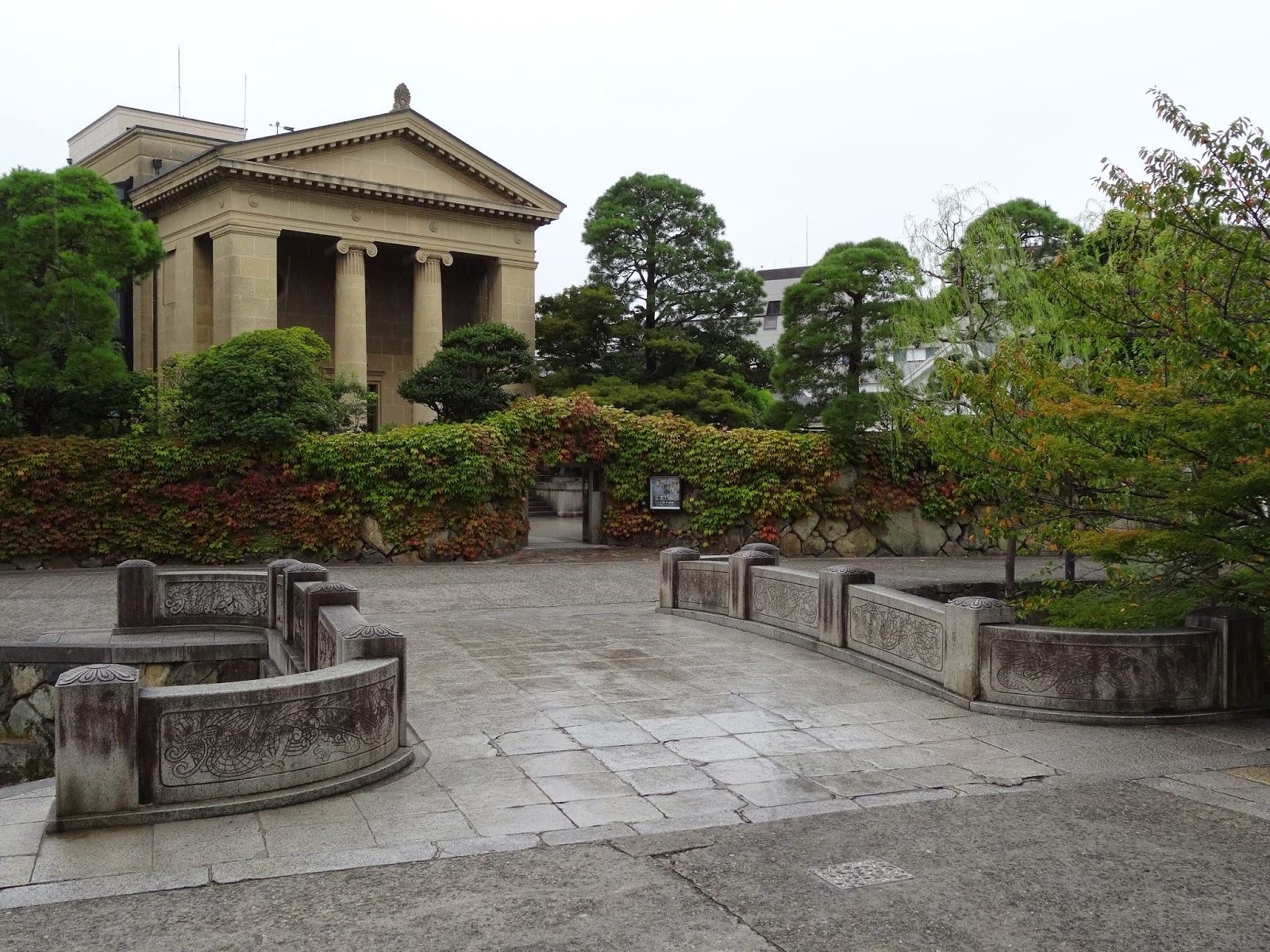
I found much to aesthetically appreciate in the museum's buildings
as well as its collection of art, crafts and ancient artefacts

I also enjoyed my time strolling about and exploring

Even when it includes the sight of a graveyard,
I still find this Kurashiki old city scene to be very pretty
 
 Consider this: this beautiful building is home to a working bank! :O
 
 Even if this store's targeted customers are tourists,
they still come across as pretty Japanese -- or, at least, 
into Japanese culture, traditional and contemporary! ;b

Thursday, January 29, 2015

Korakuen - Okayama's most famous and popular attraction by far

Okayama Castle functions well as "borrowed scenery"
for nearby Korakuen

It wasn't fall yet when I visited but there was enough diversity 
in the colors and shades of the foliage to please my eye :)

An aged photographer focused on some brightly colored flowers
whereas I was more interested in the laid out planks that,
together, formed a bridge over calm water

Puppet Ponyo lends a brighter color to the overall green picture ;b

On my most recent Japan trip, I spent the majority of the nights in Okayama, the capital of Okayama Prefecture and the second largest city in the Chukogu Region after Hiroshima.  However, like many other visitors to the area, I only spent time in one tourist attraction in this city with a population of slightly over 700,000 -- electing to spend the bulk of my daylight hours in neighboring locales (such as Bitchu-Takahashi).

Put another way: Okayama is a convenient base for the area -- not least due to it being a major stop on the Shinkansen's Tokaido-Sanyo Line.  But there's really only one place in the city that is considered a "must visit" for both internal and foreign tourists -- and, actually, it's a real doozy.

Among the Japanese, Korakuen is commonly considered to be one of the three most beautiful gardens in the country (with the other two being Mito's Kairakuen -- which I've yet to visit -- and Kanazawa's Kenroku-en -- which I had the good fortune to visit last May).  And Korakuen is where I headed on the morning of the second day of my September Japan vacation.

Completed in 1700, Korakuen falls into the category of Japanese garden that's my favorite: i.e., stroll(ing) gardens. As their name implies, these type of gardens were made for -- and are best appreciated by -- leisure strolling about and around their grounds, often revealing different landscapes as one looks at it from different angles and sections.
 
At 28 acres (or 11 hectares) in size, Korakuen is larger and more spacious than most other Japanese gardens.  And it also stands out from most other of the country's stroll gardens by having large expanses of grassy space and also a rice "field" along with such as the requisite pond and (artificial) hills.
 
In addition, Korakuen is one of those gardens with more than one genuine Shinto shrine within its grounds.  And while Okayama-jo lies outside rather than within the garden, the castle's proximity to Korakuen makes for it being part of the pleasing scenery on view when visiting this famous Okayama locale. :)