Monday, September 7, 2015

A hike with views of the Big Buddha, Ngong Ping 360, and more! (Photo-essay)

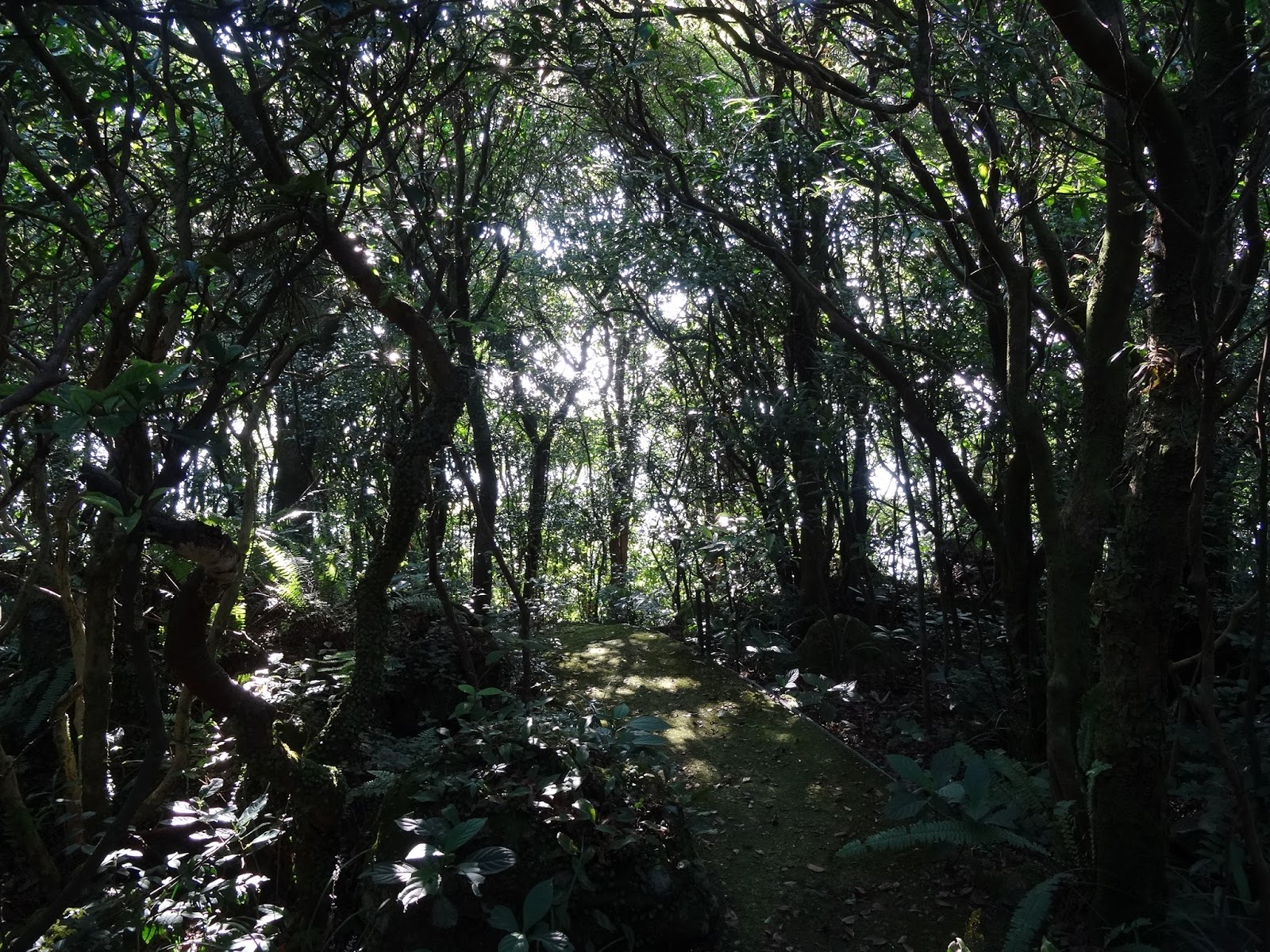
I fell in love with the Nei Lak Shan Country Trail pretty much from the first time that I went on it; and so much so that, upon looking back at year's end, it qualified as my favorite hike of the year. I've seen gone on that trail a couple more times -- and always on a hot summer's day since it's usually several degrees cooler up on the Ngong Ping Plateau and its surroundings than much of the rest of Hong Kong.  And it was on another hot summer's day that I went there once more -- albeit with a different hiking buddy from on the previous occasions.  

Because the Nei Lak Shan Country Trail is a fairly new path, and has been closed due to there being landslides in the area before being reopened some months later, many people -- even veteran Hong Kong hikers -- don't know about its existence.  I have to admit that there's a part of me that wants to keep it a secret, as I definitely don't want to see the trail get crowded.  However, I also do think it's such a nice trail, which yields lots of stunning sights, that it does deserve to have more people appreciating it... ;b

During the early part of this hike, one gets to see 
the Big Buddha from a number of different angles :)

The Ngong Ping 360 cable car ride is also visible
from sections of the Nei Lak Shan Country Trail :)

For all the grand scenic views to be had, one should also
make sure to look down, to ensure that one doesn't
accidentally step on cool critters like this cricket! 

It was so clear that day that we could see a number of
the islands to the west of Lantau! :O

A green grasshopper that looks pretty different from 
the brown cricket we spotted earlier on in the hike 

Town and country, and water, land and sky in one photo! :b

I wonder how many people at the airport, in the planes 
and cable cars know that there's good hiking to be had 
not that far away from where they are :)

Yes, there really is a section of the hiking trail
that's directly underneath the path of the cable cars :b

Sunday, September 6, 2015

A Tale of Three Cities, Mabel Cheung's wanna-be historical epic (film review)

Hong Kong, the port-city that the protagonists in
Mabel Cheung's A Tale of Three Cities looked upon as a safe haven

A Tale of Three Cities (Hong Kong-Mainland China, 2015)
- Mabel Cheung, director
- Starring: Lau Ching Wan, Tang Wei, Qin Hailu, Jing Boran

"It was the best of times, it was the worst of times" -- thus goes the famous quote from Charles Dickens' A Tale of Two Cities.  The title of Mabel Cheung's first directorial effort since 2003 clearly references the classic English novel.  But what's less certain is which are the three cities referred to in her movie's title since the only cities I saw featured in the film were Shanghai and Hong Kong, with the other locale (in Anhui province) being more village than urban metropolis. 

If only that were my only problem with this ambitious feature film which was inspired by the true story of Jackie Chan's parents (that also was the subject of Traces of a Dragon: Jackie Chan & His Lost Family, the documentary Cheung helmed in 2003).  Because as much as I wanted to like a cinematic offering by the same filmmaker who helmed such as the touching Eight Taels of Gold (1989) and intriguing The Soong Sisters (1997), the truth of the matter is that I found myself shifting uncomfortably in my seat for a good part of the screening of A Tale of Three Cities this afternoon, and opting out of attending the post-screening Q&A with this disappointing film's director (rather than ply her with queries that she might look upon as on the hostile side).

One major problem as far as I was concerned stemmed from this historical drama's story not unfolding unchronologically but, rather, beginning in 1951 in Hong Kong, with Fang Daolong (Lau Ching Wan, billed as Sean Lau in the film's English language credits) working as a cook up on The Peak and trying hard to persuade his beloved, Chen Yuerong (Tang Wei), to make the danger-filled journey across the border from mainland China.  In one fell swoop, then, a lot of tension in many of the scenes that were set in earlier times dissipated since however life-threatening were many of the situations that Daolong and Yuerong were depicted in pre-1951, the viewer already knew that they managed to survive them!

While one could argue that people already knew that Daolong and Yuerong survived into the 21st century on account of their still having been alive when Mabel Cheung made her 2003 documentary, A Tale of Three Cities was/is supposed to be only inspired by, rather than closely based on, the lives of Jackie Chan's parents.  On a related note: a second accusation leveled at this wanna-be historical epic is that it actually underplays the extraordinary lives of those two real-life individuals, one of whom had actually been a major underworld figure (something his filmic alter-ego was not depicted as being), with the other's idea of fun at one stage involving her striding into a casino with a horse-whip in her hand (something else not shown happening in this film!)! 

Instead, the two protagonists in this sadly underwhelming film come across as an illiterate but good-hearted widower with two sons and the impoverished widow with two daughters and a mother with bound feet that he -- over the course of his carrying his duties as a police officer -- discovers resorting to trafficking opium in a desperate attempt to provide for her loved ones; with their two best friends (played respectively by Jing Boran and Qin Hailu) having the more colorful strands of background and personality that the real life Fang Daolong and Chen Yuerong (who came by her Western name "Lily" while working for a Western family in Shanghai) possessed.

Giving this state of affairs, it stands to reason that Jing Boran and Qin Hailu's characters actually seem more interesting than those portrayed by leading actor Lau Ching Wan and leading actress Tang Wei.  Worse is there being a distinct lack of chemistry between Lau and Tang that make it hard for this (re)viewer to believe that Daolong and Yuerong were truly made or meant for each other as well as actually worthy of focus intead of the supporting characters compellingly portrayed by the promising Jing and appealing Qin.

In fairness to the film's first-billed star: Lau was not helped by his having been partially dubbed (in those scenes where his character speaks Mandarin).  On the other hand, Tang Wei really doesn't have much of an excuse of once again not convincing in a meaty role -- and I have to confess to being tired of seeing her in plum parts (including in Ann Hui's The Golden Era and Ivy Ho's Crossing Hennessy) in movies that probably would have benefited greatly from having more genuinely able actresses in them.

To be sure, I understand the commercial imperatives for the film having Tang Wei in its cast -- and do see that it's more historically accurate for the bulk of this Hong Kong-mainland Chinese co-production to be in Mandarin.  However, it's also true enough that A Tale of Three Cities left me pining for a now bygone era where Hong Kong's directors weren't tasked with making big budget cross-border commercial hits and, instead, could be left to produce smaller scale works that truly told personal stories and touched the heart.

My rating for this film: 5.5  

Saturday, September 5, 2015

Hiking inside Kadoorie Farm and Botanic Garden, up to and down from Kwun Yam Shan

There's not much of a view at all 
from the very top of Kwun Yam Shan!

Lower down the 546-meter-high hill, however,
scenic vistas are indeed on offer :)
 
And for good measure, near the very top is an area
that could well be called dragonfly alley! ;b
 
On a cold winter's day with unseasonably clear skies a few years back, two friends and I hiked up 546-meter-high Kwun Yam Shan.  Although much of our ascent was on a paved road within the Kadoorie Farm and Botanic Garden rather than a genuinely wild part of Hong Kong, it still felt like quite the accomplishment upon our getting up to the top of the hill on account of that road leading up it being one of the steepest I've ever been on.
 
So I'm not quite sure what possessed me to suggest to a different hiking buddy that we hike up Kwun Yam Shan this afternoon, on a day for which the Hong Kong Observatory had issued a very hot weather warning!  And you know what?  We did manage to do just that, albeit only after shedding buckets load of sweat as well as huffing and puffing quite a bit along the way!
 
Unlike the previous time I visited this conservation and education center that was set up in 1956 on a site near Lam Tsuen, I didn't spend much time checking out the attractions in the lower reaches of Kadoorie Farm and Botanic Garden.  Instead, my friend and I focused on getting up the hill named after the Goddess of Mercy using, for the most part, a different route from the one I had previously gone up on.  
 
On the map I had of the place, the Pillars Path looked to take a pretty direct path up from the lower part of Kadoorie Farm and Botanic Garden to a corner of the facility which now is home to four granite pillars which used to be a part of the old General Post Office building in Central that visually was far more impressive than that which replaced it in 1976.  So we decided to go up it, particularly as it also was a nature trail that we figured would be visually interesting. 
 
Almost unbelievably, it actually was harder to go up than the steep road that snakes its way up the hill -- not least because some sections of it were ultra slippery due to their being covered by lichen.  So I actually was happy that a good bulk of our hike was, in fact, on a road; though we did also go along the easier Enkianthus Walk for a bit and, on the way down, onto the Butterfly Path which actually didn't yield that many butterfly spottings and encounters!
 
To give an idea of how much easier it was to go down then up the hill: I'd estimate that we took about 70 minutes to get up but less than 30 minutes to get down!  And while I had initially thought we could stop at the T.S. Woo Memorial Pavilion on the way from Kwun Yam Shan, the truth of the matter is that we were far too exhausted to entertain thoughts of checking out more sights, especially when they required our detouring more than a few meters from our charted path to the bus stop closest to the Kadoorie Farm and Botanic Garden's exit, from where we'd be making our way home! :)   

Friday, September 4, 2015

Geological and other sights in the more remote sections of Hong Kong's northeast (Photo-essay)

On the way to the sixth stop on yesterday's boat tour which included time spent on the islands of Check Chau (aka Port Island), Ap Chau (aka Robinson Island) and Kat O (aka Crooked Island), I noticed that I had taken more than 60 photos at that stage in the excursion, and mentioned it to one of the group's members.  She ruefully told me that she had taken so many photos on her smartphone that its battery had run out of power!

Those two remarks should give a good idea how many cool and interesting sights we saw on the northeastern Hong Kong tour that also included visits to Wong Chuk Kok Tsui, Hung Shek Mun, Sam A Tsuen and Lai Chi Wo.  And for good measure, here's offering up 8 photos taken yesterday -- in addition to those I already put at the top of yesterday's blog post -- that I hope will drive home that point (even while I also grant that they'd have been better if there had been more sunshine when I took them!):-

 A view of Chek Chau from the sea, with a waterfall
as the surprise icing on the cake


Not only can reddish rocks be found at Hung Shek Mun (Red Rock 
Door/Passage) but some of them also are honeycomb shaped! 

The clear, calm waters add to the area's beauty

I'd visited Sam A Tsuen a few times before but this was
the greenest I have seen it and its surroundings being

 In this part of the world, the green and rural areas belong to
Hong Kong while the more built-up areas are in mainland China!
(click on the photo to enlarge and boggle your mind! ;b)

Someone on Kat O's a fan of Vincent van Gogh's Sunflowers ;)

From the terrace in front of Kat O's Tin Hau temple, 
one can see duck shaped Ap Chau, and Shenzhen's high rises

Thursday, September 3, 2015

A boat tour that included visits to Chek Chau, Ap Chau and Kat O

I don't know why Port Island is so called in English but
the reason for its Cantonese name of Chek Chau
(i.e., Red Island) should be clear from this photo of it!

Ap Chau (Duck Island in Cantonese)'s famous sea arch is 
the "eye" of the duck that the island is thought to be shaped like :)

Kat O (aka Crooked Island)'s buildings attest to it once being 
home to a thriving community -- but a walk around 
it this afternoon shows how quiet it now is

Upon getting back into my apartment this evening, my pedometer showed that I had walked over 17,000 steps today.  But although these are the kind of the numbers I rack up on a day when I go hiking, I actually spent a good bulk of today on a boat as well as dry land!  

More specifically, I went on a boat tour to some of the less accessible parts of Hong Kong, including the islands known in Cantonese as Chek Chau, Ap Chau and Kat O.  And while the term "boat tour" may have one thinking that all we did was view sights from a boat, we actually got off at the seven places that the boat we were on stopped at before returning to Wong Shek Pier to walk about, including up to a hilly ridge on Port Island, to view the Devil's Fist from up close at Wong Chuk Kok Tsui, for lunch at Sam A Tsuen, and to visit the 18th century Tin Hau Temple at Kat O.   

Of the places visited today, I had only previously been to Sam A Tsuen and Lai Chi Wo -- both via long-ish treks that started off at Wu Kau Tang.  But although they're picturesque places that I was happy to make repeat visits to, today's highlights really involved finally stepping onto sections of Hong Kong that I had long liked to but hadn't seriously aspired to do so because they are islands that there are no regularly scheduled ferry or kaito services to.

Prior to today, the closest I had ever got to Chek Chau (AKA Port Island) was from nearby Tap Mun and the kaito a friend and I took from Sham Chung to Wong Shek Pier earlier this year.  With its pier having fallen into disrepair, it was quite an adventure to get on to this uninhabited island which sits at the mouth of Tolo Harbour as well as to tramp several meters uphill to get scenic views of the island and beyond (including Tung Ping Chau and the sections of Mainland China closest to Hong Kong's easternmost outlying island), with the scramble downhill scaring me into "butting it" at some points.

Several sighs of relief could be heard after our tour guide assured us that Chek Chau was the most difficult of the places we'd be visiting to get around.  And I can confirm that Ap Chau and Kat O -- both of them inhabited and boasting intact piers (and, in the case of Kat O, a surprisingly large one for an island with no longer that many residents!) -- were a good deal easier to get onto as well as move about on.

Geologically of interest for being the only two places in Hong Kong where breccia is found, Ap Chau and Kat O also are interesting culturally, including for reasons related to the main religion practiced on the two islands.  More specifically, the 0.04 square kilometer sized (i.e., pretty small!) island of Ap Chau was uninhabited until the 1950s, when a village was set up by members of the True Jesus Church, while Kat O's Tin Hau Temple is home to not just the usual one but two Tin Hau figurines -- one of which, legend has it, floated over the water from Lai Chi Wo some 4 kilometers away!

At first glance, both Ap Chau and Kat O look to have significant populations.  But I'd believe what I've since read -- that Ap Chau only has fewer than 10 residents these days -- since I saw a total of 5 inhabitants in the around half an hour that we were on the island.  And while Kat O was by far the most built-up of the places we visited today, the fact that there's no longer a school on the island says volumes about the age and diminished size of its population. 

The sense I have, particularly with Kat O and Lai Chi Wo of the places we visited today, is that if they were more accessible (e.g., had regular ferry or kaito services to them), they'd be able to attract more visitors and interest, and maybe also more people willing to live there.  Looking at the broader picture: it can seem rather strange how it is that so many people in Hong Kong have problems finding affordable accomodation on the one hand and how there also really are whole, large swathes of the Big Lychee that are not occupied by humans and/or cannot attract people to stay there.   

Wednesday, September 2, 2015

The distinctively contemporary Japanese Hero 2015 (movie review)

Advertising for one of many movies -- 
this one Japanese -- with Hero in its title!

Hero 2015 (Japan, 2015) 
- Masayuki Suzuki, director
- Starring: Takuya Kimura, Takako Matsu, Keiko Kitagawa, etc.

On January 8, 2001, a legal drama debuted on Fuji TV that not only would achieve the highest series ratings on Japanese TV in 25 years but also go on to spawn a mini-series in 2006, a second series beginning in 2014 and two movies.  Starring singer-actor Takuya Kimura (of J-pop boy band SMAP) as the titular hero, the film versions at least operate more as ensemble works than one might have expect, given their lead actor's superstar status and the works' titles singular (rather than plural) emphasis. 

Without having watched any of the episodes of the original Hero or any its made-for-TV follow-ups, I still managed to enjoy the first film version of Hero when I saw it in a Hong Kong cinema back in October 2007.  So when I learnt that there was a new Hero film out (known as Hero The Movie in some territories and given the title Hero 2015 here in Hong Kong), I looked forward to checking it out -- even while realizing that I actually couldn't remember all that much about the first Hero film that I had seen eight years ago! 

But although its makers obviously do assume that viewers of Hero 2015 have some prior knowledge of the Hero universe, I found it fairly easy to mentally slip into the world inhabited by the film (and TV phonemena)'s characters.  Among other things, its makers' vision of a contemporary Japan which tries hard to be humane and tolerate (even welcome) individual idiosyncracies, even while showing how people work best when they are part of a team -- and backed by their teammates -- will be familiar to those who've watched a number of other contemporary Japanese films (including ones as diverse as feel good comedy Wood Job!, and the Umizaru coastguard action series that's also produced by Fuji TV).

It also helps that Hero 2015 sees the return of a former member of the Tokyo District Public Prosecutors Office to the Jozai Branch along with her assistant from the Osaka office that she now belongs to.  This way, her successor, Chika Asagi (Keiko Kitagawa), needs to be brought up to speed -- and the film's audience can be along with her -- as to the part that the now Osaka-based Maiko Amemiya (Takako Matsu) played in both the personal as well as professional life of Asagi's current boss, ace public prosecutor Kohei Kuryu (Takuya Kimura); and Asagi's current assistant, Takashi Ichonose (Koji Ookura), needs to be introduced -- and the film's viewers can be along with him -- to the other colorful characters working at the Jozai Branch!

The reason for Amemiya and Ichonose hurrying to Tokyo is that they learnt of the death in Tokyo of an Osaka-based hostess there.  Kuryu and Asagi were assigned to investigate the car crash that resulted in the woman's death.  After arriving at her former office, Amemiya informs the public prosecutors there that the deceased was a key witness in a bribery case involving the yakuza, after which it's realized that the circumstances of her death may not be as cut and dried as they had initially appeared.

Further complications ensue when it is discovered that the woman's death took place on a street situated next to the embassy of Neustria (a country one of the characters describes as being young at just 600 years; something which this Malaysian found pretty amusing given her country's really tender age!).  Because foreign diplomats have extraterritoriality, the Japanese officials can't go about investigating the case(s) in a conventional way.  

But given how unconventional acting Kuryu is prone to be, it could be described as fortuitous that he's one of the officials involved!  And so it turns out, with interesting -- and at times also pretty amusing -- results that take in such as musings on what's capable of crossing borders, the discoveries that Neustrians love sausages and petanque, and -- but of course! -- various members of the Josai Branch doing their bit to bring the investigations to a success, and the Osaka public prosecutors too! 

Hero 2015 isn't for everyone -- not least those who will want their movie heroes to be, well, more conventionally heroic!  It's also a work that has a noticeable TV show style (particularly with regards to its lensing) as well as links; one which the less generous may describe as not very sophisticated, and even downright hokey.  Despite it hardly being a perfect film though, I still found it to be an enjoyable watch on a big screen: thanks in no small part to it being the kind of film where the good not only triumph but the generous spirited are likely to find kindred spirits, including in seemingly unlikely -- and foreign -- places. 

My rating for this film: 7.0    

Tuesday, September 1, 2015

Views from and of Peng Chau (Photo-essay)

Before I moved to Hong Kong more than eight years ago now, I already had been on a few of the Big Lychee's Outer Islands.  Being on Lantau was a given on account of it being home to Hong Kong's main airport as well as the Big Buddha, more than one guidebook made a trip to Lamma seem like a "must do" and each repeat viewing of Riley Ip's Just One Look made me yearn all the more to visit Cheung Chau.  

But I only learnt about Peng Chau's charms after moving to Hong Kong.  Funnily enough, the two people who heaped praise on that which at least one website has billed as "Hong Kong's underdog island" were not locals.  And both the French banker I got to talking with a pub and Taiwanese theater director-playwright Stan Lai (whose one Hong Kong-based play, Writing in Water, includes scenes set on Peng Chau) did enough to make me want to visit the island -- and on more than one occasion too, actually! ;b

Photographic proof that one can indeed spot the 

On super clear days, things can look closer than they actually
are -- and make Peng Chau and Lantau seem connected!

 The island's not known for its beaches but this doesn't 
mean that people can't have fun on one there ;)

Not the usual vantage point from which people view and photograph
Kowloon, Victoria Harbour and Hong Kong Island! ;b

I didn't get to the quiet eastern side of Peng Chau on my first visit, 
and I'd wager that many visitors to the island don't check it out either

I had fun watching this man playing with his remote 
control boat out on Peng Chau's Tung Wan :)

Some people may deem it unattractive but I actually think that
there's a charm to that house by the sea -- and figure
that, at the very least, it's got nice views!

From the ferry, it's easy to see why locals
have nicknamed Peng Chau Flat Island :b